• Hi and welcome to the Studio One & Studio Pro User Forum!

    Please note that this is an independent, user-driven forum and is not endorsed by, affiliated with, or maintained by Fender. Learn more in the Welcome thread!

Stuck with a clipping track...

Distort = pull or twist out of shape.

Any dynamic processing distorts by the pure nature of it, changing the signal irreversibly (unlike e.g. EQ'ing). It certainly doesn't have to sound bad and it can even be inconspicuous to the untrained ear, but it won't be the same signal anymore. 'Shaving off' is the basic nature of limiting. Sure you (or the chosen limiter) can be smart about it, but in the end the peaks/projections will have to be gone-ish or the signal will clip like before.:)

My post was about the basic process of fighting clipping, setting it apart from the pure loudness of a mix. By calling it an art I also wanted to say that the subject is deeper than just adding a simple limiter.;)
 
That is not, how it is related. Any codec that alters the source material has a chance to go above 0 dBTP although you mastered at -1 dBTP. The factors are not the codec used, but the musical situation and how the codec deals with it. But you said "clip higher". I want to point out that there is no clipping. We are in the analog realm. There is no such thing as "it clips, when over 0 dBTP". In the digital realm the limit is absolute. Higher than 0 dBFS and it clips. In the analog realm that doesn't exist. Instead it is dependent on the hardware used to listen to your music, what exactly might happen. There definitely will not be clicks or something like that. On most hardware you won't even notice occasional peaks well above 0 dBTP.

If your goal is not to provide a solid, good sounding source, but to prevent the digital master to ever go beyond 0 dBTP, you have to consider the LUFS goal, you master for. For example, at -16 LUFS, -1 dBTP will guarantee that (scientifically, so the usual "with a probability bordering on certainty"). But at -6 LUFS you might need to tweak it down to -2 dBTP. that is all just a broad example, in the end the specific music with the specific LUFS goal and its specific dynamic range decides that. And you will never know it, because only on the end user's hardware is it actually happening or not happening, without the user even noticing it.

But, this is then just a master that prevents occasional peaks above 0 dBTP at all costs. It doesn't sound better, it doesn't do anything positive for your music. It just prevents a digital value from appearing, before it gets transferred into the analog realm.
OK, thank you for the clarification. I believe you understood my point: a signal mastered to a -1.0 dBTP limit is generally safe for streaming or platform-based normalization. However, when a track is purchased—on platforms like Beatport, Bandcamp, Apple, Amazon or so on—it can be downloaded in various codecs. This creates a real challenge for most artists, as the source file is typically a 24-bit/44.1 kHz WAV, yet there is usually no way to provide a separate, codec-specific master for each format offered by these platforms.

If we assume that a conversion process inadvertently generates inter-sample peaks (ISPs) that exceed the -1.0 dBTP limit set in our master, we arrive at the crux of the matter:
If I’ve understood you correctly, the quality of the listener's playback device then becomes the deciding factor in whether or not we hear artifacts caused by clipped peaks (which were due to the conversation originally above 0 dBFS but not on the original .wav). Is that correct? Please confirm—I believe this aligns with what I was assuming.

Given this, and looking at the analysis provided by my distributor—which shows that 96.2% of my streams occur on mobile devices—I have to wonder: might a -1.5 dBTP limit actually be worthwhile? Furthermore, I assume that when users download tracks for offline listening, they may end up with lower-quality codecs—at least, that is my technical understanding. Please correct me if I am mistaken. For me, this exceptionally high proportion is further evidence that purchased content in which codec ever is indeed being played back on these very devices—and I highly doubt that everyone in Germany is willing to spend between €250 and €580 on Apple AirPods. This is especially relevant given that the economy here has been in a sharp decline for quite some time—to the point where people are now looting shops during public gatherings, making off with, say, three left-footed Nike shoes. And, according to the analysis, Germany isn’t even my top-performing country.

In this context—specifically for electronic music (leaning toward trance)—would you consider it more advisable to master to -1.5dBTP, while aiming for a loudness level around -10 LUFS (rather than -6 LUFS) and attempting to maintain a dynamic range of approximately DR9?

***
>Translated with Google<
***
 

Attachments

  • Screenshot 2026-11-08 at 18.21.45.png
    Screenshot 2026-11-08 at 18.21.45.png
    47 KB · Views: 8
OK, thank you for the clarification. I believe you understood my point: a signal mastered to a -1.0 dBTP limit is generally safe for streaming or platform-based normalization. However, when a track is purchased—on platforms like Beatport, Bandcamp, Apple, Amazon or so on—it can be downloaded in various codecs. This creates a real challenge for most artists, as the source file is typically a 24-bit/44.1 kHz WAV, yet there is usually no way to provide a separate, codec-specific master for each format offered by these platforms.
Yes, I understood. And I tried to explain, that even the various codecs are already taken into account, when the decision for -1 dBTP was made. In short: the very popular recommendation of -14 LUFS at -1 dBTP is a generalized safe space. Most pop/rock/electronic productions will never exceed 0 dBTP in whatever codec on the end user's device. Orchestral and similar productions will be safe with -20 LUFS (for more dynamics) at -1 dBTP. As any generalized range, it has its limits. The more you compress towards the digital limit, the more likeliness for the analog signal to go over the capacity of the hardware. See last paragraph.


If I’ve understood you correctly, the quality of the listener's playback device then becomes the deciding factor in whether or not we hear artifacts caused by clipped peaks
Yes and no. I'm hesitating, because I'm not sure, wether you are into the technical side of all this. Please don't feel offended when I go into detail over this!
In the digital realm, we only have sample points. each one representing the amplitude at that exact moment in time. Between them is nothing. No information. The term for this is "discrete values". That is a property of the digital realm only. In the analog realm, there is always a continuous signal. If you could zoom in on a sound, you would never see emptiness, like in the digital realm, there always is a value. It is the task of the DAC to reconstruct a continuous signal from the few sample points. It does so using an algorithm. The result is a curve of values, no matter how far you would zoom in. The example image shows the sample points of the digital realm as black squares and the reconstructed continuous signal from the DAC in grey. The signal will always be curved. And if we assume, that the top 2 sample points are at 0 dBFS, it becomes clear that while this is totally valid in the digital realm, the analog signal in grey will exceed this digital limit. That's ISP, and it is measured in dBTP. However, this is just a propability. A true peak meter does not know the exact specifications of all DACs out there. When it shows 0 dBTP, it is actually saying "around 0 dBTP. It could be -0.5 or +0.3 just as well, depending on the used hardware. But more important: The grey curve is what exists in the analog realm, it is the signal that leaves the DAC for the amplifier and speakers. And that signal doesn't change. It is exactly that signal. Now, how does analog "clipping" occur? It is important to understand, that it does not occur in the DAC! The grey line will never be flattened or something like that! What happens is that the hardware has some voltage and power. Let's say, it has a 5 Volt system, which means it can raise or lower voltage between 0 and 5 Volt. The DAC is referencing that scale. But, at that peak of the example image, it tells the amp "go up to 6 Volt". The amp doesn#t have that voltageand so it stays at 5 Volt for the whole time between the two sample points instead of gradually rising and falling. That would be analog clipping. It sounds like high frequency noise if it happens often. You don't notice it if it happens once or twice. in allcases it is a limitation of the analog hardware rather than a corrupted signal. This is really important. The signal is totally fine and intact, the hardware just can't follow. some DACs reference lower voltage ranges to compensate, so you don't even run into analog clipping, for example a 3 Volt range on a 5 Volt amp. That's why it is so difficult to say anything definitive. In theory your question would be answered "yes", but in practice it is rarely occuring.

sample_points.png


In this context—specifically for electronic music (leaning toward trance)—would you consider it more advisable to master to -1.5dBTP, while aiming for a loudness level around -10 LUFS (rather than -6 LUFS) and attempting to maintain a dynamic range of approximately DR9?
This is such a "highly compressed towards the top end" situation. Disregard codecs, this dense music mix will make it very likely to have a large overshoot. I would even recommend -2 dBTP to make sure. This not because of the -10 LUFS goal, but because of the very small dynamic range of 9 dB.

But please, consider that you might be too obsessed. You will not prevent all situations, where the hardware hits its physical limits. For example, even at your current -1.5 dBTP it is still a valid master that most of your audience will enjoy without any noticable distortion.
 
This is such a "highly compressed towards the top end" situation. Disregard codecs, this dense music mix will make it very likely to have a large overshoot. I would even recommend -2 dBTP to make sure. This not because of the -10 LUFS goal, but because of the very small dynamic range of 9 dB.
Thank you very much for this detailed answer and information.

Last thing to say here is that i thought DR9 is a good sweetspot from what i read so this makes a bit confused now. But i am currently trying to test a new way of mixing for me with compressors and i hope to get better dynamics. The idea was parallel compression on the instrument/audiochannel with channel link enabled and on the fx-channels 100% wet, channel link off and ducking on reverb and delays (by the audio source of the channel) but on the bus parallel compression again with channel link off just to glue the instrument with its effects together.
Of course there will be real sidechain ducking (volume ducking) on the bus-groups.
I am looking for a kind of perfect system that just works fine. In theory this should give me better dynamics, don't you think?
 
Last edited:
Last thing to say here is that i thought DR9 is a good sweetspot from what i read so this makes a bit confused now.
Don't be. I am answering without any experience in Trance mixing. If it is on the better side of things for the genre, that's fine.

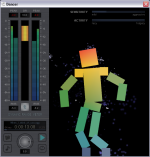
I personally mix with higher DR. Funnily enough, here's a screenshot from an app I programmed 16 years ago. Back then, I didn't care for LUFS (I didn't know about it). I was mixing for straight 0 dBFS. The app loads .ogg files and an animated figure has limbs that react to the audio source in various ways with IK and 2D physics applied. This leads to a unique dancing performance for each song.

Why I show you the screenshot? Because even back then, when going for 0 dBFS, I still had way higher dynamic ranges (although electronic music!). Like the 18.8 dB in the screenshot.
 

Attachments

  • dancer.png
    dancer.png
    123,2 KB · Views: 8
Don't be. I am answering without any experience in Trance mixing. If it is on the better side of things for the genre, that's fine.

I personally mix with higher DR. Funnily enough, here's a screenshot from an app I programmed 16 years ago. Back then, I didn't care for LUFS (I didn't know about it). I was mixing for straight 0 dBFS. The app loads .ogg files and an animated figure has limbs that react to the audio source in various ways with IK and 2D physics applied. This leads to a unique dancing performance for each song.

Why I show you the screenshot? Because even back then, when going for 0 dBFS, I still had way higher dynamic ranges (although electronic music!). Like the 18.8 dB in the screenshot.
Geil 😂😂😂
 
@Grace de Richebourg

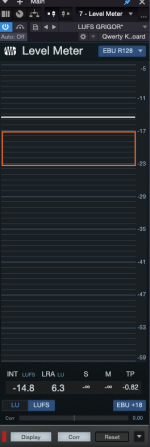
It does but you find it in LRA. But, i have to say here i`ve got a lack of eduaction and missing knowledge. I am not an engineer and can`t give you an answer to which valua of the DR Scale it matches. I am using true:Level from sonible but it measures Dynamic Range in PSR. I´ve read it`s more modern and optimized for nowadays standards. While i`m currently rebuilding/rework and older mostly broken Project, i`m around 13 in the Dynamics. So i hav'nt compared with an DR-Meter to it`s ccale but i think it goes that way i'm trying to archive as far as i can hear and see. I´ll see that later one day how it works out.

But i would like to know if there is table with a scale to compare how it matches. Would be helpful.
Not sure, if I understand correctly, but you can't compare the old crest factor calculation and modern Peak to Short Term Loudness. In my app, you can see the old crest factor working: The highest peak is measured against the RMS over a short time window in dB units. But in PSR you measure the highest true peak against short term loudness in LU units. It is not directly comparable. The latter is more precise or accurate, as I could trick crest factor calculations with long fadeouts or similar shenanigans. PSR only measures at the highest 20% of peaks to prevent that.

But again, I might have misunderstood!
 
@tulamide

No, no you did not, you're right. I was hoping if there could be a kind of comparable list between LRA on the Level Meter and a standard DR measurement.
 
Back
Top