

Surf.Whammy
Active member
TECHNICAL INFORMATION AND THOUGHTS ON VST 2.4, VST 3, AND DOUBLE-PRECISION ARITHMETIC FOR FSP 8
For reference, Reason 13 (Reason Studios) is 64-bit only and does not support 32-bit VST plug-ins; so if you have Reason 13, then it has scanned all your plug-ins and will scan any new plug-ins you add to your system.
I am testing Fender Studio One Pro 8 with 64-bit "Process Precision" (double-precision floating point arithmetic) for the "mix engine" after switching from single-precision to double-precision; and after adding Tonalic Essential (Celemony), both applications (Reason 13 and Fender Studio Pro 8) rescanned the plug-ins and reported no plug-ins were blocked.
Whether it did the plug-in rescan with focus on 32-bit or 64-bit is another matter, for which at present I have no information, although intuitively since Fender Studio Pro 8 is a 64-bit only application in macOS and Windows, it probably does the same plug-in scan. In other words, it appears there are not separate plug-in scans for 32-bit vs. 64-bit.
For reference, I suggest this because no matter how I set Fender Studio Pro 8 for "Process Precision", it does not flag any of my VST effects plug-ins. Additionally, it appears logical that there would not be separate and independent plug-in scanning algorithms depending on the setting of mix-engine "Process Precision".
Google AI reports "Fender Studio Pro 8 only supports 64-bit VST3 and AU plug-ins", but I am not certain what that suggests when Fender Studio Pro 8 has the option for single-precision or double-precision mix-engine "Process Precision".
This is what the Fender Studio Pro 8 "Reference Manual" says, "Fender Studio Pro features a cutting-edge high-precision mix engine. A mix engine is the “number cruncher” that does the mathematical summing required to mix multiple sources of digital audio. Fender Studio Pro employs a floating point, mixed-mode engine."
Google AI reports "Fender Studio Pro 8 is a 64-bit application."
From all this, I infer that running Fender Studio Pro 8 with 32-bit "Process Precision" requires doing what one might call algorithmic "downsizing" from 64-bit "Process Precision", whatever that entails.
The information on VST from Steinberg is that VST 2.4 is 32-bit and some VST 2.4 plug-ins are 64-bit; but VST 3 is 64-bit only and does not support VST 2.4. Steinberg moved to VST 3 in 2018, when it dropped VST 2.4 support.
Whether 32-bit VST is supported depends on the Digital Audio Workstation (DAW) application, although in macOS on M1+ machines, VST 2.4 is not supported, hence plug-ins need to be VST 3.
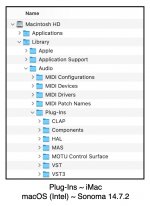
Windows has a separate directory where VST 2.4 plug-ins are stored, as does macOS.
Windows (Intel, AMD) supports VST 2.4 and VST 3, as do Intel-based Apple machines; but Apple M1+ machines support only VST 3.
SAMPLE RATE AND RECORD FORMAT CONSIDERATIONS
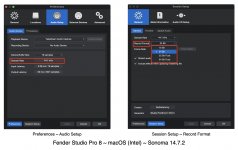
Two more things to consider the (a) sample-rate and (b) "record format" (a.k.a., "sample-rate resolution).
Based on the fact that both (a) standard CD (44.1-kHz) and (b) standard Audio for Video (48-kHz) are industry standards and are completely sufficient in every respect for working with audio that humans are able to hear, this tends to suggest that more emphasis on Digital Audio Workstation (DAW) applications and VST.2.4 and VST 3 plug-ins is provided or given to 44.1-kHz and 48-kHz sample-rates, since higher sample-rates mostly are marketing gimmicks and, according to acoustic physics and material reality, do absolutely nothing other than make technically confused people "happy", where the defining rule colloquially is called "Nyquist" and was discovered and defined at Bell Labs by Harry Nyquist in 1928, nearly 100 years ago.
What Fender Studio Pro 8 calls the "record format" also has an affect on the way everything works, although at the moment I have no concise idea about it, other than (a) 16-bits and (b) 24-bits appear in various bit-rate standards and refer to the number of bits transferred per unit time (usually seconds for audio), where for example the Red Book Standard CD format is 16-bit depth, which according to Google AI "Defines the resolution and dynamic range (difference between the softest and loudest sounds), providing a high-fidelity, 96 dB range".
The standard for audio in Video is 16-bits but 24-bits is preferred, and according to Googlel AI "provides a 144 dB dynamic range for high-fidelity, low-noise recordings".
Similarly, Google AI provided that "64-bit floating-point audio (64-bit float) provides a dynamic range of over 1,500 dB".
This tends to suggest that one of the techniques major recording labels and mastering engineers use to produce the best possible audio perhaps maps to using 64-bit floating-point audio (64-bit float), which is something I am going to explore with a few experiments--observing that I have been able to create "ballpark" audio with good frequency response compared for example to the remasters version of "Dazed and Confused" (Led Zeppelin), and the current official version of "Lux Æterna" (Metallica).
[NOTE: I included the recent experiment with what I call "Quantum Sonic Entanglement (QSE) Sparkles", and all three of these YouTube music videos are best enjoyed with listening with studio-quality headphones like SONY MDR-7506 headphones, where in particular I am very happy with the deep bass and sustained tail of my new Kick Drum sound. ]
QUESTIONS
(1) Are the reported problems with VST plug-ins a matter solely of outdated versions?
(2) Does this happen on Apple M1+ machines?
(3) Was Fender Studio One Pro 8 tested primarily in macOS on M1+ machines and not on Apple Intel-based machines?
(4) Is anyone having the "plug-in" problem on the Mac?
(5) Is it even possible that extensive testing of Fender Studio Pro 8 was done at the higher, non-standard sampling rates?
(6) Are the reported problems with VST plug-ins occurring on machine set to use higher, non-standard sampling rates?
(7) What "Record Format" are folks using?
(8) Considering that Fender Studioi Pro 8 is a 64-bit application in macOS and Windows, does it make sense to do everything in 64-bit floating point (double-precision) exclusive with VST 3 plug-ins and corresponding Fender native format plug-ins (when they are 64-bit), as well as Reason Rack Plug-in VST, which of course by design is VST 3 only (and also AU on the Mac)?
[NOTE: I did an experiment where I changed everything to 64-bit floating point (double-precision), and the volume level of my recent song on "sparkles" nearly doubled when played back in Fender Studio Pro 8, which solves a long-standing puzzle here in the sound isolation studio.
For reference, the current YouTube music videos were not changed; so this only occurred when I played the song in Fender Studio Pro 8 and suggests another few experiments to determine how it affects YouTube audio, which for reference is processed by YouTube with its own internal audio processing technology, hence (a) you mix and master using your technology and then (b) YouTube masters your master (uploaded audio). ]
For reference, Reason 13 (Reason Studios) is 64-bit only and does not support 32-bit VST plug-ins; so if you have Reason 13, then it has scanned all your plug-ins and will scan any new plug-ins you add to your system.
I am testing Fender Studio One Pro 8 with 64-bit "Process Precision" (double-precision floating point arithmetic) for the "mix engine" after switching from single-precision to double-precision; and after adding Tonalic Essential (Celemony), both applications (Reason 13 and Fender Studio Pro 8) rescanned the plug-ins and reported no plug-ins were blocked.
Whether it did the plug-in rescan with focus on 32-bit or 64-bit is another matter, for which at present I have no information, although intuitively since Fender Studio Pro 8 is a 64-bit only application in macOS and Windows, it probably does the same plug-in scan. In other words, it appears there are not separate plug-in scans for 32-bit vs. 64-bit.
For reference, I suggest this because no matter how I set Fender Studio Pro 8 for "Process Precision", it does not flag any of my VST effects plug-ins. Additionally, it appears logical that there would not be separate and independent plug-in scanning algorithms depending on the setting of mix-engine "Process Precision".
Google AI reports "Fender Studio Pro 8 only supports 64-bit VST3 and AU plug-ins", but I am not certain what that suggests when Fender Studio Pro 8 has the option for single-precision or double-precision mix-engine "Process Precision".
This is what the Fender Studio Pro 8 "Reference Manual" says, "Fender Studio Pro features a cutting-edge high-precision mix engine. A mix engine is the “number cruncher” that does the mathematical summing required to mix multiple sources of digital audio. Fender Studio Pro employs a floating point, mixed-mode engine."
Google AI reports "Fender Studio Pro 8 is a 64-bit application."
From all this, I infer that running Fender Studio Pro 8 with 32-bit "Process Precision" requires doing what one might call algorithmic "downsizing" from 64-bit "Process Precision", whatever that entails.
The information on VST from Steinberg is that VST 2.4 is 32-bit and some VST 2.4 plug-ins are 64-bit; but VST 3 is 64-bit only and does not support VST 2.4. Steinberg moved to VST 3 in 2018, when it dropped VST 2.4 support.
Whether 32-bit VST is supported depends on the Digital Audio Workstation (DAW) application, although in macOS on M1+ machines, VST 2.4 is not supported, hence plug-ins need to be VST 3.
Windows has a separate directory where VST 2.4 plug-ins are stored, as does macOS.
Windows (Intel, AMD) supports VST 2.4 and VST 3, as do Intel-based Apple machines; but Apple M1+ machines support only VST 3.
SAMPLE RATE AND RECORD FORMAT CONSIDERATIONS
Two more things to consider the (a) sample-rate and (b) "record format" (a.k.a., "sample-rate resolution).
Based on the fact that both (a) standard CD (44.1-kHz) and (b) standard Audio for Video (48-kHz) are industry standards and are completely sufficient in every respect for working with audio that humans are able to hear, this tends to suggest that more emphasis on Digital Audio Workstation (DAW) applications and VST.2.4 and VST 3 plug-ins is provided or given to 44.1-kHz and 48-kHz sample-rates, since higher sample-rates mostly are marketing gimmicks and, according to acoustic physics and material reality, do absolutely nothing other than make technically confused people "happy", where the defining rule colloquially is called "Nyquist" and was discovered and defined at Bell Labs by Harry Nyquist in 1928, nearly 100 years ago.
What Fender Studio Pro 8 calls the "record format" also has an affect on the way everything works, although at the moment I have no concise idea about it, other than (a) 16-bits and (b) 24-bits appear in various bit-rate standards and refer to the number of bits transferred per unit time (usually seconds for audio), where for example the Red Book Standard CD format is 16-bit depth, which according to Google AI "Defines the resolution and dynamic range (difference between the softest and loudest sounds), providing a high-fidelity, 96 dB range".
The standard for audio in Video is 16-bits but 24-bits is preferred, and according to Googlel AI "provides a 144 dB dynamic range for high-fidelity, low-noise recordings".
Similarly, Google AI provided that "64-bit floating-point audio (64-bit float) provides a dynamic range of over 1,500 dB".
This tends to suggest that one of the techniques major recording labels and mastering engineers use to produce the best possible audio perhaps maps to using 64-bit floating-point audio (64-bit float), which is something I am going to explore with a few experiments--observing that I have been able to create "ballpark" audio with good frequency response compared for example to the remasters version of "Dazed and Confused" (Led Zeppelin), and the current official version of "Lux Æterna" (Metallica).
[NOTE: I included the recent experiment with what I call "Quantum Sonic Entanglement (QSE) Sparkles", and all three of these YouTube music videos are best enjoyed with listening with studio-quality headphones like SONY MDR-7506 headphones, where in particular I am very happy with the deep bass and sustained tail of my new Kick Drum sound. ]
QUESTIONS
(1) Are the reported problems with VST plug-ins a matter solely of outdated versions?
(2) Does this happen on Apple M1+ machines?
(3) Was Fender Studio One Pro 8 tested primarily in macOS on M1+ machines and not on Apple Intel-based machines?
(4) Is anyone having the "plug-in" problem on the Mac?
(5) Is it even possible that extensive testing of Fender Studio Pro 8 was done at the higher, non-standard sampling rates?
(6) Are the reported problems with VST plug-ins occurring on machine set to use higher, non-standard sampling rates?
(7) What "Record Format" are folks using?
(8) Considering that Fender Studioi Pro 8 is a 64-bit application in macOS and Windows, does it make sense to do everything in 64-bit floating point (double-precision) exclusive with VST 3 plug-ins and corresponding Fender native format plug-ins (when they are 64-bit), as well as Reason Rack Plug-in VST, which of course by design is VST 3 only (and also AU on the Mac)?
[NOTE: I did an experiment where I changed everything to 64-bit floating point (double-precision), and the volume level of my recent song on "sparkles" nearly doubled when played back in Fender Studio Pro 8, which solves a long-standing puzzle here in the sound isolation studio.
For reference, the current YouTube music videos were not changed; so this only occurred when I played the song in Fender Studio Pro 8 and suggests another few experiments to determine how it affects YouTube audio, which for reference is processed by YouTube with its own internal audio processing technology, hence (a) you mix and master using your technology and then (b) YouTube masters your master (uploaded audio). ]
Attachments
Last edited:


