
-
Hi and welcome to the Studio One & Studio Pro User Forum!
Please note that this is an independent, user-driven forum and is not endorsed by, affiliated with, or maintained by Fender. Learn more in the Welcome thread!
You are using an out of date browser. It may not display this or other websites correctly.
You should upgrade or use an alternative browser.
You should upgrade or use an alternative browser.
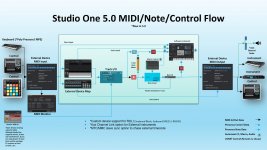
Signal Flowchart
- Thread starter dlsmusic
- Start date

TheMaartian
Member

OP
OP

dlsmusic
Member
Thank you TheMaartian!
Didn't the Studio One manual have something similar at one point? I though I remembered seeing one that looked more like a traditional flowchart in portrait mode. Maybe I'm just imagining it. Or maybe it was something in the Cakewalk manual when I was using Sonar.
In any case, thanks again for the quick response!
Didn't the Studio One manual have something similar at one point? I though I remembered seeing one that looked more like a traditional flowchart in portrait mode. Maybe I'm just imagining it. Or maybe it was something in the Cakewalk manual when I was using Sonar.
In any case, thanks again for the quick response!

lokeyfly
Well-known member
Thete were no signal flowcharts of this sort from the Studio One manuals. The flow chart you see here was created and maintained by a user who later was employed by Presonus as I recall. He [Jepetit] voluntarily kept the flowchart going during his tenure, only I haven't herd from him in a while. The one provided here looks to be up to revision 5. Use it with some allowance for changes (understandably) now incorporated into the latest Studio Pro version 8. I think it would be a very good idea if someone grabbed the baton and updated it. Particularly if Studio Pro is going to present itself as a pro DAW. There are times when users will have signal flow questions that could immediately be answered with a concise signal flow chart. Be it pre/post fader, insert, bus patching, VCA faders, etc.Didn't the Studio One manual have something similar at one point? I though I remembered seeing one that looked more like a traditional flowchart in portrait mode. Maybe I'm just imagining it. Or maybe it was something in the Cakewalk manual when I was using Sonar.
We shall see, but it's an undertaking by someone detailing such signal paths, acurately.
OP
OP
dlsmusic
Member
I would have offered to take on that task, but I just don't have the bandwidth, nor do I have the technical knowledge of what's going on under the hood to do so. I have however created a feature request to include such a flowchart in the manual. I would imagine that the development team already has such a thing.

Gary Shepherd
Active member
With drag and drop I really have no idea what I would do with such a Flowchart or why it matters. I'm interested to know why it is important to some users. Thanks.

I’ve never really felt the need for a signal flowchart in Studio One.
The signal flow is already right there in the mixer (inserts, sends, buses) - it’s all visible and pretty self-explanatory. Turning that into an abstract diagram feels redundant to me.
I get that it might help beginners, but to me it’s more something you’d need in a less intuitive system.
The signal flow is already right there in the mixer (inserts, sends, buses) - it’s all visible and pretty self-explanatory. Turning that into an abstract diagram feels redundant to me.
I get that it might help beginners, but to me it’s more something you’d need in a less intuitive system.
OP
OP
dlsmusic
Member
Hey Gary. Personally, I find it useful to understand or troubleshoot gain staging issues, meter levels, effect levels, etc. It depends how your mind processes things I guess. Those who wouldn't find it useful would just ignore it if it were added to the manual.With drag and drop I really have no idea what I would do with such a Flowchart or why it matters. I'm interested to know why it is important to some users. Thanks.
Gary Shepherd
Active member
Oh I understand it - I used to work as an engineer at IBC Studios in Portland Place in the mid 70's - an analogue 16 track studio - so signal flow etc was fundamental. Just can't see what the point is in this DAW - but that is just me.Hey Gary. Personally, I find it useful to understand or troubleshoot gain staging issues, meter levels, effect levels, etc. It depends how your mind processes things I guess. Those who wouldn't find it useful would just ignore it if it were added to the manual.

SwitchBack
Well-known member
Flowcharts visualise answers to questions like: Is Event FX before or after Clip Gain? Or: Is this or that level control printed when you bounce? We're not all visual thinkers, but those who are immediately gravitate to pictures like these.
TheMaartian
Member
Yup. Someone, somewhere coined the phrase "a picture is worth a thousand words" for a reason.We're not all visual thinkers, but those who are immediately gravitate to pictures like these.

I think it’s possibly more important to old farts like me who used analog gear and patch bays.
Like when users say they don’t even use the mixer view? I need the mixing console to follow the signal path which since the beginning of time is top to bottom and generally left to right.
Mixing in track view to me would be always confusing like someone turning my console counter clockwise 90 degrees! Like even meters don’t make sense to me if they are horizontal!
Like when users say they don’t even use the mixer view? I need the mixing console to follow the signal path which since the beginning of time is top to bottom and generally left to right.
Mixing in track view to me would be always confusing like someone turning my console counter clockwise 90 degrees! Like even meters don’t make sense to me if they are horizontal!
SwitchBack
Well-known member
Not an age think I'd say. Of the 3 or 4 learning styles 'learning by doing' (tactile) and 'learning by hearing' are heavily over-represented in the music industry. Visual learners (as preferred style) are a small minority and are sometimes overlooked. The fault isn't yours 
Last edited:
lokeyfly
Well-known member
Yeah, all good takes on behalf of those who see the need for it, or even don't. A signal routing flow chart as its name implies was certainly more prominent with hardware mixers. I would spend days comparing different models based on routing features. While many brands had typical layouts especially around insert points (to hookup FX, and possibly bypass pre or post fade routings, etc. Some boards were more applicable to live (house) conditions, stage (monitor mix), or studio. Often avoiding the need for patchbays, particularly for live shows. Today, you either learn by doing in the home Studio, or not care because you simply dont care about routings, or what gets rendered along with your bounces, stems, or otherwise. You figure what works for your needs, and your interface general routing/monitoring. No biggie, and thats fine.
However, the questions can come up for those users who have more of a stake in a live band in a studio with perhaps a discreet monitor mix. A request comes up and a mix engineer has to have an immediate way to route a signal, yet the other performers each want their own tailored unique mix. That might impact some signal pre fader channels while others are post fader, bus, or talk back setups. Etc.
If you dont need it, then you're largely in shape to not worry about it. Or, you have patchable alternatives. A signal routing diagram for a DAW, audio interface, or mixing console is there for particular questions for those needing such routing answers. So its important in a signal routing chart for all paths, switching, meter positions, and I/O to obviously be accurate. Jeff (JPettit) did a remarkably good job filling that need. I'd take it on myself, but as someone mentioned, bandwidth is maxed. It's really an insider job on a technical front. All routing(s) accurate, short and concise.
Its effectively the signal schematic. For many, not to worry. Your hands-on learn-by-doing approach will largely be enough......... for you. Others have their valid needs. Fender will decide if they are to pick up those pieces. By the looks of their user base, I suspect they won't. If they even know what the hell we're talking about. (insider joke)
However, the questions can come up for those users who have more of a stake in a live band in a studio with perhaps a discreet monitor mix. A request comes up and a mix engineer has to have an immediate way to route a signal, yet the other performers each want their own tailored unique mix. That might impact some signal pre fader channels while others are post fader, bus, or talk back setups. Etc.
If you dont need it, then you're largely in shape to not worry about it. Or, you have patchable alternatives. A signal routing diagram for a DAW, audio interface, or mixing console is there for particular questions for those needing such routing answers. So its important in a signal routing chart for all paths, switching, meter positions, and I/O to obviously be accurate. Jeff (JPettit) did a remarkably good job filling that need. I'd take it on myself, but as someone mentioned, bandwidth is maxed. It's really an insider job on a technical front. All routing(s) accurate, short and concise.
Its effectively the signal schematic. For many, not to worry. Your hands-on learn-by-doing approach will largely be enough......... for you. Others have their valid needs. Fender will decide if they are to pick up those pieces. By the looks of their user base, I suspect they won't. If they even know what the hell we're talking about. (insider joke)
Last edited:
OP
OP
dlsmusic
Member
Thanks to everyone for chiming in with your thoughts. For those of you who would like to vote for the request, here's the link:

 feedback-software.fender.com
Audio and MIDI Signal Flowchart | Documentation | Fender Studio Pro
It would be extremely helpful to include a MIDI and audio signal flowchart in the reference manual. This could potentially clear up many questions users have regarding the function...
feedback-software.fender.com
