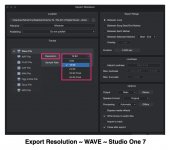
At the risk of being annoying, I suggest there are only two sample rates which make sense, (a) standard CD quality (44.1-kHz) and (b) high-fidelity audio quality for standard video (48-kHz), the latter of which is 48-kHz because it's easier and faster for doing the required arithmetic in the software engineering code, not because it's somehow better than 44.1-kHz. The audio sample rate for standard video is higher than standard CD audio solely for faster computer processing. If you are doing audio for standard video, then use 48-kHz, but otherwise use 44.1-kHz, although there are some not so goofy reasons for using 96-kHz, but probably not in a truly practical way.
Why?
It's all about the rule colloquially called "Nyquist", which states that the sample-rate needs to be a little more than twice the highest-frequency that needs to be captured and reproduced, which for "normal" human hearing (20-Hz to 20-kHz) and maps nicely to 44.1-kHz, while 48-kHz extends the range approximately to 24-kHz, which is too high to hear but is done to make the computer arithmetic more efficient.
I wrote something about this in an earlier post; but the overview is that higher than standard sample rates are based on beliefs rather than acoustic physics and are in the same category as paying thousands of dollars for "magic music crystal rocks" based on the belief that sticking them with tape to headphones somehow will make music sound better, hence why not send thousands of dollars to the people who make absurd claims and sell "magic music crystal rocks".
Those also are the folks who sell USB cables for hundreds of dollars based on the belief and marketing strategy that their USB cables are "magical".
Digital Audio Workstation (DAW) applications and sampled-sound libraries support higher sample rates, because some folks think it's important and actually does something. Higher sample rates do
nothing, but if folks like a 2-liter Coca-Cola rather than a 1-liter Coca-Cola, then sell it to them.
This is explained fully by electrical engineer Monty Montgomery in the YouTube video; and he proves it using analog and digital measuring equipment and a software charting application.
OBSERVATION
The Standard CD and Standard High-Fidelity Audio for Video (44.1-kHz and 48-kHz) are completely and totally sufficient for the best possible audio reproduction for human listeners, provided the amplifiers, loudspeakers, headphones, and ear buds are high-quality, where the curious fact about amplifiers and loudspeakers is best understood from the perspective of sound system engineers who do sound at concerts and as a group care only about the quality of the various components but are not the least bit influenced by marketing testimonials made by famous musicians and singers.
Instead of being influenced by learning that a famous lead guitar player uses a particular amplifier and loudspeaker rig made by Fender, Marshall, Orange, and so forth, sound reinforcement folks consider it mostly to be consumer marketing strategies, although there are valid reasons for different types of guitar amplifiers.
If there is a rule, then it's that the general goal of deceptive marketing is to extract as much money from consumers as possible while providing as little as possible.
One of my favorite bits of audio marketing is found in terms like "near field", which certainly sounds vastly important but actually means in simple English that "you need to get close to it to hear anything".

George Martin explained the rules best when he revealed that he added a 17-kHz tone at the end of the "Sgt. Pepper's Lonely Hearts Club Band" (Beatles) vinyl LP to "entertain dogs", which was his way of having a bit of silly FUN like the Beatles did and providing the clue that nearly nobody actually can hear those high frequencies.
Another favorite is "sea salt", which sounds exciting and tasty--except that all the salt found on this planet is sea salt. If the salt comes from salt mines in Kansas, then it's just as much "sea salt" and probably is
cleaner than salt evaporated now from sea water.
In other words, sound reinforcement engineers are focused on
acoustic physics rather than marketing puffery.
This is the reason you can have an excellent studio monitor system using PA loudspeakers and subwoofers used for nightclubs and small venues. They are not endorsed by famous musicians, hence do not cost a lot; but they are quite sufficient and generally are less expensive than other types of studio monitor systems, at least the ones that make deceptive claims and use marketing terms like "music power" and boast vastly large "music watts" and other nonsense.
I recommend two flavors of studio monitors, (a) Kustom PA two-way loudspeakers and deep bass subwoofers and (b) PreSonus Sceptre® S8 Studio Monitors (pair) and Temblor® T8 Studio Subwoofers (pair).
I do this for three reasons (a) folks who understand acoustic physics and concert sound know how to configure PA loudspeakers safely and have OSHA-approved ear protection for use while configuring, (b) the PreSonus studio monitors have accurate and truthful specifications, which is rare in the arena of commercial off the shelf (COTS) studio monitors and is something I checked and verified, and (c) the PreSonus studio monitors can be calibrated and configured safely by folks who are not complete and total audio geeks. The only other studio monitors I recommend are the ones by JBL Pro that cost $20,000 (US) with the required Crown power amplifiers, cables, and all that stuff, all of which needs to be connected to an external interface and at least an equalizer for calibrating where you need two deep bass subwoofers because you have two channel stereo and while you can use one deep bass subwoofer, doing it that way causes the subwoofer's self-powered electronics to do the deep bass mixing, not you.
SUMMARY
It's important for sample-rates to be consistent, and it's important that the sample-rate supports Nyquist for normal human hearing, which is just a bit over twice the highest frequency humans can--at least in theory--hear, which is 20-kHZ and maps to 44.1-kHz (Standard CD quality).
A sample rate of 48-kHz also is good; and it's what is used in high-fidelity audio for video.
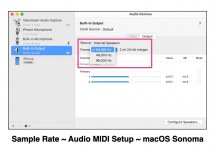
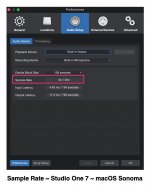
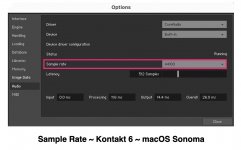
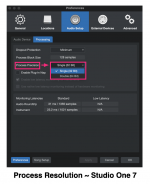
All the components in the digital music production chain have sample-rates, and they need to be the same, which generally is specified in Studio One, macOS or Windows, external digital audio and MIDI processors, and so forth, which also includes VSTi virtual instrument engines like Kontakt (Native Instruments).
The sample rates need to be the same.
[
NOTE: The sample rate in the Settings dialog is the exactly same for Kontakt 6, Kontakt 7, and Kontakt 8, which I verified after doing the Kontakt 6 screen capture.]