What one considers harsh or silky with audio is quite subjective.
Also, the remedy depends on whether you're dealing with a stereo mix (my example above) or can remix individual tracks. But since it was a general question, here's some general advice about one technique that's worked for me. Hopefully others will find it useful.
The ear is most sensitive between 1 and 6 kHz, with peak sensitivity between 3 and 4 kHz. So, more energy in that range raises the potential for harshness or stridency. To begin de-harshing a mix, loop the range that sounds the harshest. (If the harshness is throughout the song, then loop the part with the most instruments playing together.)
The first goal is to find the tracks that
don't contribute to harshness. Mute, then unmute, individual tracks one at a time to see if the sound becomes less harsh when a track is muted. Leave the non-harsh-contributing tracks unmuted, but you can ignore them in the following.
Still with a looped section, the next goal is to find what's building up in the upper midrange. Here's the important part. Individual tracks will often sound okay by themselves, so to chase down harshness, play
combinations of tracks (particularly layered synths and tracks with saturation). Deal with the tracks that contribute the most to the harshness, using EQ. Make any EQ edits in context with the music.
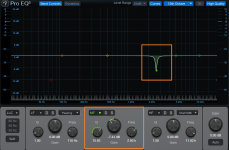
Finally, back to mastering for a second. The EQ curve shown above is like what I've used on some stereo files given to me for mastering. The client thought they sounded "strident." These were acoustic sessions. The problem was that all instruments had been tracked in the same room, and it had a room resonance that you couldn't really hear with a soloed instrument. But when mixing, multiple instruments playing in the same range at the same time generated a pretty strong level bump around the resonant frequency. Reducing that one resonance solved the problem.