

Surf.Whammy
Active member
Rollback the clock to the 1950's when electromagnetic tape machines appeared after Ampex in the late-1940-'s updated the electromagnetic tape machines the Allies discovered after the Second World War that the Germans had developed in 1927 and subsequently were used by NAZI Minister of Propaganda Joseph Goebbels to create scripted radio programs which were broadcast to the German people for listening with official NAZI radio receivers.
Based on this, one can suggest with some credibility that the music of the second half of the 20th century and the current music of the early-21st century literally, physically, and electromagnetically traces back to the NAZI electromagnetic tape recording techniques of the 1930's and 1940's, which curiously included using a different set of technologies to broadcast television programs of the 1936 Olympics in Berlin, Germany.
Ampex was funded by Bing Crosby, who was interested in having the ability to record his radio shows and then to play the resulting recorded programs in different time zones without needing to perform the programs over-and-over for each of the time zones.
Bing Crosby was well aware of a young guitarist, Les Paul, and his interest in recording songs; and Bing gave Les Paul a pair of Ampex one-track electromagnetic tape machines, which Les Paul then altered to have an additional playback head for sound on sound recording and used to record the hit songs of Les Paul and Mary Ford, where the strategy was to record a layer of playing and singing and then to record a new layer while the first layer was being played, as demonstrated in the 1951 recording of "How High The Moon" (Les Paul and Mary Ford).
It's useful to know that Les Paul designed the now classic Gibson Les Paul electric guitar and also designed and built his own custom recording studio, including the mixing board and everything else.
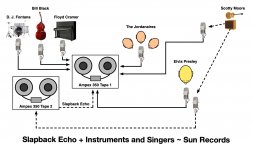
By the mid-1950's this strategy was used by Sam Phillips at Sun Records to record Elvis Presley and other singers, where in particular Sam Phillips developed a technique called "slapback echo" using two Ampex tape machines, where one recorded the instruments and singing while the second Ampex tape machine recorded Elvis Presley's singing through a different microphone and then this recording was played back in real-time at a slight delay and was fed to the first Ampex tape machine, thereby creating the delay effect called "slapback echo", which is most easily heard in "Great Balls of Fire" (Jerry Lee Lewis).
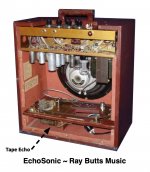
It's useful to know that Scotty Moore, Elvis Presley's guitar player, had a custom designed amplifier made by Ray Butts which had a magnetic tape delay unit.
Fast forward to the mid-1960's and early-1970's, and there were multitrack magnetic tape machines and correspondingly advanced mixing boards, which were used to record and mix the albums "Sgt. Pepper's Lonely Hearts Club Band" (Beatles) and "Dark Side of the Moon"(Pink Floyd), both done at Abbey Road Studios. At the same time, "Dazed and Confused" (Led Zeppelin) was recorded at a different studio and was produced by lead guitarist Jimmy Page using basically the same techniques but enhancing it with more elaborate panning, which was possible because everything was monaural in those days, as to a practical extent it continues to be in modern recording studios, although for the most part not in Digital Audio Workstation (DAW) applications unless it's done monaurally by design and intent.
Going back to the days when music was recorded to Edison wax cylinders using huge metal "horns" as microphones, the various song production activities were separated into four general categories by the focus on important work:
(1) Recording Engineer, who was responsible for ensuring the musical performances were captured accurately with good signal levels, clearly, and with no distortion or noise
(2) Audio Engineer, who was responsible for adjusting the sounds and mixing based on direction from the Producer
(3) Producer, who was responsible for the overall sound and theme of songs and collections of songs (a.k.a.,"albums")
(4) Mastering Engineer, who was responsible for ensuring the recorded and mixed music was put into proper sonic format for manufacturing with the various types of media (wax cylinders, platters, vinyl records [33 and 1/2 RPM, 45 RPM, and 78 RPM], cassette tapes, CD and DVD, and most recently streaming audio on the web and other delivery platforms).
These are general categories, and there are overlaps, of course; but it's sufficient to develop a key insight into the way things continue to work.
The first and most important step in recording a song is focused on what colloquially is called "good levels"; and this is paramount, because everything else depends on the recorded music and singing having good levels with a focus generally as being as accurate and noiseless as possible, which using an analogy, metaphor, or simile is like ensuring you have correctly prescribed correction lenses for your glass, if you need to wear glasses, or have had your eyes checked by an ophthalmologist to ensure you are seeing accurately and correctly.
The goal at this step is to capture the performances accurately--not to start enhancing things and doing elaborate producing.
One of the important aspects of this step involves calibrating the various equipment and in the case of magnetic tapes adding a reference tuning tone at the start of the reel.
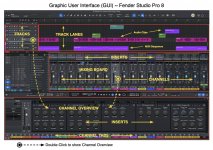
Since modern DAW applications like Fender Studio Pro 8 are patterned after the way things where done in the 1960's and 1970's, the "Mix" view of Fender Studio Pro 8 is an analog, metaphor, or simile for a professional recording studio and its equipment, were the Track Lane maps to the channels of a reel of magnetic tape; the Channels map to the mixing board, and the Inserts map to external racks of signal processors.
The high-level rule for this maps to using a VU meter or the LED volume level indicators, as well as compressor-limiters, brickwall limiters, noise gates, and various equalizers to ensure there are good levels with minimal noise.
It's also useful to know that songs usually were recorded on one magnetic tape reel at a time, although live performances would be recorded on a continuous reel so that more than one song was on the magnetic tape reel.
As a song and album developed, the audio would be mixed to two channels and recorded to two-channel magnetic tape, which then would go to the Mastering Engineer to be prepared for manufacturing.
For this reason, history suggests the best focus on producing, audio-engineering, and mastering is on a song-by-song basis, which is supported strongly in Fender Studio Pro 8, where one of the important considerations involves using a tailored set of signal processors ("Inserts", if you prefer) with specific preset parameters so that a coherent set of songs will have the same overall sound from the perspective of the Recording Engineer's tasks and the resulting collection of songs will not be vastly different in basic tones and textures with respect to good levels, noise control, and so forth, which is supported by the way things were done historically with successful results.
Again, the focus is on ensuring the music and singing sounds "good" in the same way as the hamburger patty and buns of a McDonald's hamburger are not overcooked and burned. There are other considerations, of course; but the primary focus always is on ensuring that music and singing is properly recorded using generally accepted standards and practices which have been developed and proved over decades going back the the early-1900's when Thomas Edison created the recording industry with the introduction of wax cylinders, recording devices, and player machines.
If there is a high-level summary on the Recording Engineer perspective as it applies to Fender Studio Pro 8, then it's the focus on developing a consistent set of signal processors, including VST effects plug-ins, that are used to ensure the audio for a collection of songs has similar tones and textures and sounds like a coherent set rather than a hodgepodge of things that do not fit together into a logical and pleasing Gestalt.
[NOTE: These are best enjoyed and understood when listening with studio-quality headphones like SONY MDR-7506 headphones. ]
Based on this, one can suggest with some credibility that the music of the second half of the 20th century and the current music of the early-21st century literally, physically, and electromagnetically traces back to the NAZI electromagnetic tape recording techniques of the 1930's and 1940's, which curiously included using a different set of technologies to broadcast television programs of the 1936 Olympics in Berlin, Germany.
Ampex was funded by Bing Crosby, who was interested in having the ability to record his radio shows and then to play the resulting recorded programs in different time zones without needing to perform the programs over-and-over for each of the time zones.
Bing Crosby was well aware of a young guitarist, Les Paul, and his interest in recording songs; and Bing gave Les Paul a pair of Ampex one-track electromagnetic tape machines, which Les Paul then altered to have an additional playback head for sound on sound recording and used to record the hit songs of Les Paul and Mary Ford, where the strategy was to record a layer of playing and singing and then to record a new layer while the first layer was being played, as demonstrated in the 1951 recording of "How High The Moon" (Les Paul and Mary Ford).
It's useful to know that Les Paul designed the now classic Gibson Les Paul electric guitar and also designed and built his own custom recording studio, including the mixing board and everything else.
By the mid-1950's this strategy was used by Sam Phillips at Sun Records to record Elvis Presley and other singers, where in particular Sam Phillips developed a technique called "slapback echo" using two Ampex tape machines, where one recorded the instruments and singing while the second Ampex tape machine recorded Elvis Presley's singing through a different microphone and then this recording was played back in real-time at a slight delay and was fed to the first Ampex tape machine, thereby creating the delay effect called "slapback echo", which is most easily heard in "Great Balls of Fire" (Jerry Lee Lewis).
It's useful to know that Scotty Moore, Elvis Presley's guitar player, had a custom designed amplifier made by Ray Butts which had a magnetic tape delay unit.
Fast forward to the mid-1960's and early-1970's, and there were multitrack magnetic tape machines and correspondingly advanced mixing boards, which were used to record and mix the albums "Sgt. Pepper's Lonely Hearts Club Band" (Beatles) and "Dark Side of the Moon"(Pink Floyd), both done at Abbey Road Studios. At the same time, "Dazed and Confused" (Led Zeppelin) was recorded at a different studio and was produced by lead guitarist Jimmy Page using basically the same techniques but enhancing it with more elaborate panning, which was possible because everything was monaural in those days, as to a practical extent it continues to be in modern recording studios, although for the most part not in Digital Audio Workstation (DAW) applications unless it's done monaurally by design and intent.
Going back to the days when music was recorded to Edison wax cylinders using huge metal "horns" as microphones, the various song production activities were separated into four general categories by the focus on important work:
(1) Recording Engineer, who was responsible for ensuring the musical performances were captured accurately with good signal levels, clearly, and with no distortion or noise
(2) Audio Engineer, who was responsible for adjusting the sounds and mixing based on direction from the Producer
(3) Producer, who was responsible for the overall sound and theme of songs and collections of songs (a.k.a.,"albums")
(4) Mastering Engineer, who was responsible for ensuring the recorded and mixed music was put into proper sonic format for manufacturing with the various types of media (wax cylinders, platters, vinyl records [33 and 1/2 RPM, 45 RPM, and 78 RPM], cassette tapes, CD and DVD, and most recently streaming audio on the web and other delivery platforms).
These are general categories, and there are overlaps, of course; but it's sufficient to develop a key insight into the way things continue to work.
The first and most important step in recording a song is focused on what colloquially is called "good levels"; and this is paramount, because everything else depends on the recorded music and singing having good levels with a focus generally as being as accurate and noiseless as possible, which using an analogy, metaphor, or simile is like ensuring you have correctly prescribed correction lenses for your glass, if you need to wear glasses, or have had your eyes checked by an ophthalmologist to ensure you are seeing accurately and correctly.
The goal at this step is to capture the performances accurately--not to start enhancing things and doing elaborate producing.
One of the important aspects of this step involves calibrating the various equipment and in the case of magnetic tapes adding a reference tuning tone at the start of the reel.
Since modern DAW applications like Fender Studio Pro 8 are patterned after the way things where done in the 1960's and 1970's, the "Mix" view of Fender Studio Pro 8 is an analog, metaphor, or simile for a professional recording studio and its equipment, were the Track Lane maps to the channels of a reel of magnetic tape; the Channels map to the mixing board, and the Inserts map to external racks of signal processors.
The high-level rule for this maps to using a VU meter or the LED volume level indicators, as well as compressor-limiters, brickwall limiters, noise gates, and various equalizers to ensure there are good levels with minimal noise.
It's also useful to know that songs usually were recorded on one magnetic tape reel at a time, although live performances would be recorded on a continuous reel so that more than one song was on the magnetic tape reel.
As a song and album developed, the audio would be mixed to two channels and recorded to two-channel magnetic tape, which then would go to the Mastering Engineer to be prepared for manufacturing.
For this reason, history suggests the best focus on producing, audio-engineering, and mastering is on a song-by-song basis, which is supported strongly in Fender Studio Pro 8, where one of the important considerations involves using a tailored set of signal processors ("Inserts", if you prefer) with specific preset parameters so that a coherent set of songs will have the same overall sound from the perspective of the Recording Engineer's tasks and the resulting collection of songs will not be vastly different in basic tones and textures with respect to good levels, noise control, and so forth, which is supported by the way things were done historically with successful results.
Again, the focus is on ensuring the music and singing sounds "good" in the same way as the hamburger patty and buns of a McDonald's hamburger are not overcooked and burned. There are other considerations, of course; but the primary focus always is on ensuring that music and singing is properly recorded using generally accepted standards and practices which have been developed and proved over decades going back the the early-1900's when Thomas Edison created the recording industry with the introduction of wax cylinders, recording devices, and player machines.
If there is a high-level summary on the Recording Engineer perspective as it applies to Fender Studio Pro 8, then it's the focus on developing a consistent set of signal processors, including VST effects plug-ins, that are used to ensure the audio for a collection of songs has similar tones and textures and sounds like a coherent set rather than a hodgepodge of things that do not fit together into a logical and pleasing Gestalt.
[NOTE: These are best enjoyed and understood when listening with studio-quality headphones like SONY MDR-7506 headphones. ]
Attachments

Last edited: