• Hi and welcome to the Studio One User Forum!

    Please note that this is an independent, user-driven forum and is not endorsed by, affiliated with, or maintained by PreSonus. Learn more in the Welcome thread!

Share your workspace thread

I've used Sony MDR-V6 phones for over 25 years, and replaced the plastic covered foam pads with velvet covered ones.

There's a question that I've wondered about for a long time. Back in the 1990s, there was a usenet group called rec.audio.pro. Someone posted there that the parts lists showed the only difference between the V6 and the 7506 was the cable. The V6's cable was 3 conductor; the 7506's was 4. The V6's cable had a single return for both cans.

This means that there is some amount of common impedance coupling between the two sides. I have not measured the resistance of the return path, but it can be expected to be much lower than the 32 ohms total impedance claimed by Sony.

Does anyone know more about the history of these two?

More on topic, here's one of my "monitor" speakers:
View attachment 2551

Love the pics
SO
I have asked a Sony guy in a trade booth what the difference is between the two; is it drivers, ohms, what? I told him I own both and always wondered what was the difference.

He asked me something like, "Do you notice a dissimilarity between the two?"
"Yes."
"That is the difference. How you perceive them to be different is exactly the difference between the two. "

Felt like a bit more of a philosophical lesson than anything else. I will never know, but trust what you say regarding the wires.

For what it's worth, SoundReferenceID has a different curve for both and I wouldn't be able to pick out the difference between the two in a blind test with that particular correction software enabled.
 
GREAT SPACE. Looks amazingly conducive to making great recordings. Those Genlecs RULE. Take a closer picture of the racks! I want to see what's in them! Thanks for posting!
Thank you! Everyday I am so thankful to have this space. It is a dream come true. I just create, mix and master, does not matter if I make money at this point, just happy to be doing something creative. I will try and take a few more detailed pics later. thanks again.
 
For the younger folks, that's an Altec "Voice of the Theater" 1205B studio monitor, with 15" woofer and metal high-frequency horn, where (a) the woofer handles 500-Hz and lower while (b) the high-frequency horn handles over 500-Hz to 20-kHz. Some models had two 12" woofers instead of the single 15" woofer. This is a newer model, probably from the 1970's.
I first learned about these speakers from the guys in the Lynx, a Connecticut band who won the CT Battle of the Bands 10 years in a row. They often came into the New Milford Music Center, where I worked after school, and from Barry Roma, their lead guitarist, who taught there. Doug Travers, singer and rhythm guitar, also did guitar repairs. I changed strings, tuned guitars, etc. and watched the place while Joe Santarone (a most wonderful man), the owner, went home for dinner. There were three lesson rooms, one with a piano. The others had small guitar amps. Joe, an excellent clarinetist, rented out instruments to all of the local schools' band members. We saw everything from Vibraphones to Mellotrons. What an exciting time it was!

I first heard them close up when B.B. King played at my high school. Also, when a local named Tom Rush played there, too. Then when FTA, a band derived from the Lynx, got their own Altec PA with 1203As, similar speakers that had an 800 Hz horn, I went over to hear them first hand - several times. One day they were working on a CSN&Y song that had a word that was hard to make out. Was it "Losing love, lamenting" or "Losing love, lamente?" So Doug Watts, their lead singer and rhythm guitarist, came over to the sofa where I was sitting next to a Dual turntable hooked to the PA, not far away from us. He commented that if anything could make it intelligible, it was these speakers. Then he made a comment about how I should hear how incredible the next model up sounded. I made mental note of that advice.

My next encounter with this series was in 1973, when Pink Floyd performed Dark Side of the Moon at the Waterbury Palace Theater. Wow! They had put pairs of 1205As in the back corners and midpoints of both the main floor and the balcony. Was it a 4 or 5 channel system? Bells and money sounded out from all around.

The light show was explosive and astounding. Gilmour had one stack facing forward and another facing the back of the stage. When he hit a switch on the floor, the rear facing stack came on with the glorious sound of his lead reverberating throughout the back of the stage. I don't remember much about the FOH, though.

The year of the 1205Bs? You're right! I bought these new at Sam Ashe in Portchester NY in May of 1974. I went there three Saturdays in a row. The first was to make a deposit. Things moved much more slowly then.

The second visit was to pick up what was then called "The New Super Ultimate" - a collection of Altec gear that made up a small, high quality sound reinforcement system. The total price was $3000.

We came in the door, and I was immediately annoyed at seeing them out of their shipping containers. We were told, "You guys must be doing something right; we had somebody really big in here yesterday, and they wanted to hear them. So we took them out of their cases." They informed me that my deposit had prevented them from selling them off immediately. When I got them home, I realized that they had not included the cables.

The third visit was simply to pick up the cables. To make it up to me, they had made up a good set of cables to replace the rather flimsy ones that Altec would have given me. They also told me who had wanted to hear them. It was none other than Paul McCartney.

Stuart
 
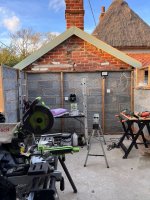
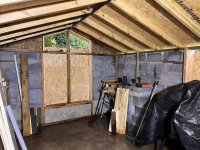
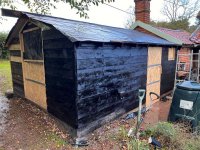
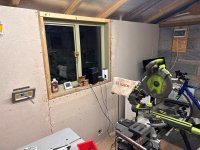
In an effort to try and avoid some of the hype and hysteria around the launch of Fender Studio Pro, I've been back outside continuing the construction of my new studio (and spare bedroom!). I started this a couple of years ago and it's made slow, but steady, progress, and I'm about to start lining it with acoustic slatted panels. I've just been playing with the desk design...

Studio Desk 3.jpg
 

Attachments

  • New Studio 1.jpg
    New Studio 1.jpg
    132,3 KB · Views: 23
  • New Studio 4.jpg
    New Studio 4.jpg
    74,1 KB · Views: 25
  • New Studio 6.jpg
    New Studio 6.jpg
    84,9 KB · Views: 25
  • New Studio 8.jpg
    New Studio 8.jpg
    56,8 KB · Views: 24
Well, yes - that's all very well, but the goal in my case is to have a domestic working room that can also be used as a studio. It's not to make a semi-professional isolated room. I have a small house (800sq ft without this building) that is 400 years old and I need to make every space work for more than one purpose.
 
They also get everywhere! But yes, I've got lots of that (rockwool, mostly), and I'll be making my own moveable sound absorbtion panels.
 
Well, yes - that's all very well, but the goal in my case is to have a domestic working room that can also be used as a studio. It's not to make a semi-professional isolated room. I have a small house (800sq ft without this building) that is 400 years old and I need to make every space work for more than one purpose.
Nice looking Fender™ Studio you're building there Tim. I'm sure you'll enjoy looking out of your Fender™ Pro Window at your Garden ©.
 
I enjoy building what essentially are plywood boxes. :)

This started when I was in junior high school and needed a bass amplifier but could not afford a Fender Showman piggy-back amplifier and loudspeaker.

Instead I found an inexpensive but large loudspeaker and built a plywood box for it, which with a small opening in front is a 'bass reflex" cabinet, although Fender piggy-backs did not have ported loudspeaker cabinets. The amplifier was made by Bogen and was equally inexpensive and worked nicely. It didn't look as nice as a Fender Showman, but it sounded good.

This is an interesting YouTube video on making a Helmholtz resonator which is larger and might be good for a bench, where the important thing is that the holes be open to the room, of course. So perhaps turned sideways so the holes are on a room-facing side and a cushion type of seat is on top of the box.

I think they can be panels, as well, so it's not just boxes.

Arc X (IK Multimedia) is good for measuring a room; and you need the version with the calibrated measurement microphone. I use it to get a graph of the room, which then provides information for where there are problems.

Arc X can be used as an active effect on the Main stereo output track, but I don't use it that way. Instead I use it to measure the room and then use various sound-absorbing strategies to get a flat equal-loudness curve.

Arc X uses the same technology that is used in concerts to set sound reinforcement system equalization, where the idea is that a sound is played in a tiny burst, and then the concert hall response is measured with a calibrated microphone. This just takes a second or so, and the audience does not notice it's being done.

Older systems required using pink-noise generators and playing pink-noise for a while, which worked but was annoying. Now it's just a short burst sound like the SONAR "ping" of a submarine.

It's the same principle as the way "impulse" reverberation measurements are made.

This might sound complex, but it's not.

These are two Helmholtz Resonator Calculators.

Helmholtz Resonator Calculator (Omni Cacuator)

Helmholtz Resonator Calculator (CalcTool)

To view this content we will need your consent to set third party cookies.
For more detailed information, see our cookies page.

To view this content we will need your consent to set third party cookies.
For more detailed information, see our cookies page.

I like the idea of a resonator bench! I’ve got Sound ID Reference, so I’ll pass on IK Arc, though I’ve heard good things about it. But that’s down the line a bit; it’s going to be a while before any sound making goes on in this building. I have lots of other things on my plate, so building work gets done when I have spare time. It’s been a couple of years so far!
 
In an effort to try and avoid some of the hype and hysteria around the launch of Fender Studio Pro, I've been back outside continuing the construction of my new studio (and spare bedroom!). I started this a couple of years ago and it's made slow, but steady, progress, and I'm about to start lining it with acoustic slatted panels. I've just been playing with the desk design...

View attachment 2778
Tim that build looks great. I've never built out my own rooms, but I'd love a space like that. How much longer until it's done? I love your desk idea. Thank you for sharing and post updates!
Discovering all this stuff can take a while, but this post has most of the important information. (y)
is it the most important information? Is it? I always figured people who said they needed completely flat monitors in completely flat spaces in completely silent rooms on power isolated blocks to mix songs were making excuses for their work.
 
Tim that build looks great. I've never built out my own rooms, but I'd love a space like that. How much longer until it's done? I love your desk idea. Thank you for sharing and post updates!

is it the most important information? Is it? I always figured people who said they needed completely flat monitors in completely flat spaces in completely silent rooms on power isolated blocks to mix songs were making excuses for their work.
Cheers Ian! Some of the remainder of the build will have to wait until the weather gets better. But it should be more or less complete by this summer. The desk is going to be a fairly major project on its own, and I'm really looking forward to tackling that - and getting the SSL UF1/UF8/UC1 to go in it! The only downside is that it's 50m away from the bar - but closer to the kitchen... The shed will be repurposed to a gym-cum-lounge bar once the transfer is complete. Luxury!

To put it in perspective, though, the new room is not much bigger than SW's sound isolation closet - around 12' square and maybe 9ft high at the vaulted peak. But it will have its own bathroom, which of course will be brilliant for vocals, especially after many beers.
 
Gorgeous. Do you have any pictures of it when it was velvet? It looks like it would be super dead. Really pretty.

Good job on getting those lights in there. Looks great.
Sadly not, and in some ways I kind of miss them. There was something about the sound that I got when I layered full strings in the velvet that was different. More rich somehow. Hey ho, I couldn't go on with them, they were literally falling apart!
Thank you! I did a fair amount of the panel building during the pandemic, and although being a remote session player meant that I actually got busier in this period, I had time on my hands at the weekends.
 
Back
Top