

Surf.Whammy
Active member
I was clicking around Studio One yesterday and a list popped-up with different strategies for panning.
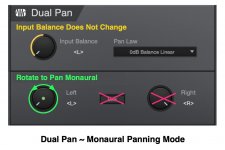
I like true monaural panning; and the only way do true monaural panning when working with stereo (two-channel) VSTi virtual instruments is to use Dual Pan (PreSonus), which works nicely, where the key is to select one of the two channels and then to use it as the monaural source. The logic for this is based on the presumption that two microphones were used when recording the audio for the sampled-sound library, or perhaps that one microphone was used when recording but the monaural source was enhanced when the samples were digitized. Either way, the presumption is that selecting one of the two channels results in having a monaural source.
There are several more types of panning; and they are different in various ways, a few of which make some intuitive sense to me, but at least two will require doing some experiments.
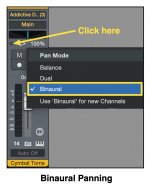
On the channel strip in the Mixer, clicking on the tiny downward arrow to the left of the panning position symbol causes a popup to appear with a set of choices {Balance, Dual, Binaural}; and there is a separate Studio One Native Effect called "Binaural Pan".
Add Dual Pan to the festival; and most of it makes intuitive sense once you understand (a) that stereo tracks by default have Balance controls and (b) Balance controls are not true monaural panning controls, because all they do is control the respective volume level of each of the two channels, where at far-left only the left channel is heard and at far-right only the right channel is heard. Explained another way, a Balance control cannot move the left channel or the right channel to top-center, far-left, far-right, or anywhere else; because a Balance control just determines the respective volume levels rather than the position or location of each channel. In other words, the position or location of the two channels is set and cannot be changed by a Balance control.
Dual Pan makes it possible to focus on one of the two channels and then to pan it monaurally.
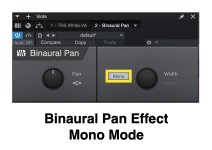
The Studio One Reference Manual explains the Binaural Pan control is doing Mid/Side (M/S) processing of the stereo track to adjust perceived stereo width from "mono to double the normal width", whatever that implies; but it has a "Mono" switch, which apparently combines the two channels into one monaural channel.
Yet the Studio One Reference Manual states that the "Pan" control "adjusts the balance in the left and right channels for the stereo track and is "variable from 100% L to 100% R", which basically is what a Balance control does. The Width control "adjusts the stereo width of the stereo track, from 0 (mono) to 200% (double stereo width)", whatever that implies. As I read it so far, the key utility is found in the "Mono" switch, which combines the two channels into a single monaural channel, which I suggest is not the same as focusing exclusively on one of the channels rather than on the sum of both channels.
Thinking aloud, I need to do some experiments to make sense of (a) the Mid/Side (M/S) and (b) the "(double stereo width)" aspects, even though I generally understand "Mid/Side (M/S)" but never use it.
"Mid" is the sum (addition) of the Left and Right signals, while "Side" is the difference (subtraction) between the Left and Right channels, which I view conceptually as "stuff in the middle, and different stuff on the sides". The problem is that it's arbitrary and is constructed from two channels, which effectively make is a different type of Balance control.
From this I infer that for practical purposes the Balance Pan control is pretty much useless and does not do true monaural panning of one channel.
The next thing to understand is what the "Pan Mode" options for the channel strip do, which intuitively maps to {Balance, M/S, Mono}, which basically is what the Binaural Pan control does, hence for doing true monaural panning also is useless.
I need to do some experiments to determine what actually happens; but intuition at present suggests neither (a) the Binaural Pan nor (b) the various types of Pan Mode do true monaural panning.
For reference, the way I do experiments to determine whether there is true monaural panning is to record myself saying "left, left, left . . . " over and over on a monaural vocal track and then "right, right, right . . ." on another monaural vocal track, followed by combining the two monaural vocal tracks into a two-channel "stereo" track in Audacity.
I did this when making sense of Dual Pan; and if I focus it on the left channel, then all I hear is "left, left, left" no matter where the panning knob is set in Dual Pan, which is excellent; because done this way I do not want to hear "right, right, right", even if it's barely audible.
There is another aspect, which might be troublesome, except that it's not so much a show stopper as yet another way to confuse everything--observing that this all started when someone had the "bright idea" to make sampled-sound libraries arbitrarily "stereo (two channel)", apparently based on thinking it would make everything somehow "better".
Specifically, one might suppose that a VSTi virtual instrument engine could send M/S content to Studio One for an Instrument Track; but if that happens, then using Dual Pan at least makes it possible to focus on one channel rather than on both channels, even if that one channel is either (a) the sum of both channels or (b) the difference of both channels.
Ideally, none of them should be sending M/S content to Studio One; but it's possible and in an odd way might make sense, although only to younger folks who do not understand that real recording studios have monaural channels and use monaural microphones or run single-channel guitars connected directly to the mixing board.
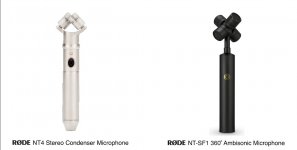
There are stereo and even more elaborate multichannel microphones; but those are not used in what I consider to be a "standard" recording studio, which essentially is like real recording studios in the 1960's and onward--no surround sound and all that stuff, which is nice but currently is not ubiquitous.
At present, (a) headphones, ear buds, and simple home and vehicle audio systems are ubiquitous and (b) they are two-channel stereo.
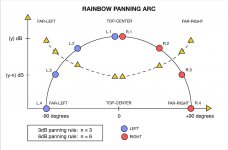
The examples I use are "Dazed and Confused" (Led Zeppelin), "Blue Ain't Your Color" (Keith Urban), "Who Owns My Heart" (Miley Cyrus), and "Billie Jean" (Michael Jackson); since when you listen to with studio-quality headphones like SONY MDR-7506 headphones (a personal favorite), (a) sounds appear in distinct panning locations on what I call the "Rainbow Panning Arc" and (b) the only way to do this is with true monaural panning controls.
I like true monaural panning; and the only way do true monaural panning when working with stereo (two-channel) VSTi virtual instruments is to use Dual Pan (PreSonus), which works nicely, where the key is to select one of the two channels and then to use it as the monaural source. The logic for this is based on the presumption that two microphones were used when recording the audio for the sampled-sound library, or perhaps that one microphone was used when recording but the monaural source was enhanced when the samples were digitized. Either way, the presumption is that selecting one of the two channels results in having a monaural source.
There are several more types of panning; and they are different in various ways, a few of which make some intuitive sense to me, but at least two will require doing some experiments.
On the channel strip in the Mixer, clicking on the tiny downward arrow to the left of the panning position symbol causes a popup to appear with a set of choices {Balance, Dual, Binaural}; and there is a separate Studio One Native Effect called "Binaural Pan".
Add Dual Pan to the festival; and most of it makes intuitive sense once you understand (a) that stereo tracks by default have Balance controls and (b) Balance controls are not true monaural panning controls, because all they do is control the respective volume level of each of the two channels, where at far-left only the left channel is heard and at far-right only the right channel is heard. Explained another way, a Balance control cannot move the left channel or the right channel to top-center, far-left, far-right, or anywhere else; because a Balance control just determines the respective volume levels rather than the position or location of each channel. In other words, the position or location of the two channels is set and cannot be changed by a Balance control.
Dual Pan makes it possible to focus on one of the two channels and then to pan it monaurally.
The Studio One Reference Manual explains the Binaural Pan control is doing Mid/Side (M/S) processing of the stereo track to adjust perceived stereo width from "mono to double the normal width", whatever that implies; but it has a "Mono" switch, which apparently combines the two channels into one monaural channel.
Yet the Studio One Reference Manual states that the "Pan" control "adjusts the balance in the left and right channels for the stereo track and is "variable from 100% L to 100% R", which basically is what a Balance control does. The Width control "adjusts the stereo width of the stereo track, from 0 (mono) to 200% (double stereo width)", whatever that implies. As I read it so far, the key utility is found in the "Mono" switch, which combines the two channels into a single monaural channel, which I suggest is not the same as focusing exclusively on one of the channels rather than on the sum of both channels.
Thinking aloud, I need to do some experiments to make sense of (a) the Mid/Side (M/S) and (b) the "(double stereo width)" aspects, even though I generally understand "Mid/Side (M/S)" but never use it.
"Mid" is the sum (addition) of the Left and Right signals, while "Side" is the difference (subtraction) between the Left and Right channels, which I view conceptually as "stuff in the middle, and different stuff on the sides". The problem is that it's arbitrary and is constructed from two channels, which effectively make is a different type of Balance control.
From this I infer that for practical purposes the Balance Pan control is pretty much useless and does not do true monaural panning of one channel.
The next thing to understand is what the "Pan Mode" options for the channel strip do, which intuitively maps to {Balance, M/S, Mono}, which basically is what the Binaural Pan control does, hence for doing true monaural panning also is useless.
I need to do some experiments to determine what actually happens; but intuition at present suggests neither (a) the Binaural Pan nor (b) the various types of Pan Mode do true monaural panning.
For reference, the way I do experiments to determine whether there is true monaural panning is to record myself saying "left, left, left . . . " over and over on a monaural vocal track and then "right, right, right . . ." on another monaural vocal track, followed by combining the two monaural vocal tracks into a two-channel "stereo" track in Audacity.
I did this when making sense of Dual Pan; and if I focus it on the left channel, then all I hear is "left, left, left" no matter where the panning knob is set in Dual Pan, which is excellent; because done this way I do not want to hear "right, right, right", even if it's barely audible.
There is another aspect, which might be troublesome, except that it's not so much a show stopper as yet another way to confuse everything--observing that this all started when someone had the "bright idea" to make sampled-sound libraries arbitrarily "stereo (two channel)", apparently based on thinking it would make everything somehow "better".
Specifically, one might suppose that a VSTi virtual instrument engine could send M/S content to Studio One for an Instrument Track; but if that happens, then using Dual Pan at least makes it possible to focus on one channel rather than on both channels, even if that one channel is either (a) the sum of both channels or (b) the difference of both channels.
Ideally, none of them should be sending M/S content to Studio One; but it's possible and in an odd way might make sense, although only to younger folks who do not understand that real recording studios have monaural channels and use monaural microphones or run single-channel guitars connected directly to the mixing board.
There are stereo and even more elaborate multichannel microphones; but those are not used in what I consider to be a "standard" recording studio, which essentially is like real recording studios in the 1960's and onward--no surround sound and all that stuff, which is nice but currently is not ubiquitous.
At present, (a) headphones, ear buds, and simple home and vehicle audio systems are ubiquitous and (b) they are two-channel stereo.
The examples I use are "Dazed and Confused" (Led Zeppelin), "Blue Ain't Your Color" (Keith Urban), "Who Owns My Heart" (Miley Cyrus), and "Billie Jean" (Michael Jackson); since when you listen to with studio-quality headphones like SONY MDR-7506 headphones (a personal favorite), (a) sounds appear in distinct panning locations on what I call the "Rainbow Panning Arc" and (b) the only way to do this is with true monaural panning controls.
Attachments
Last edited: