I'm very happy that worked out for you and that you're doing better now. I can sympathize because I had a similar experience a little over two years ago, but it was the full magilla. Open heart surgery to repair an aortic aneurysm and to replace a valve. They cracked me open like a walnut and the surgical scar is still itchy and tender 2 years later.
I'm still kind of rehabbing from that, excercising regularly, lifting weights, to eventually get back to full strength. I assume that when the artificial valve needs to be replaced in 10 years or so it will be via TAVR, not cracking me open again.
I think in the bigger picture, we're both pretty lucky.
Medicine and healthcare are a lot
better than a century ago, or even 50 years ago.
Without the TAVR procedure one-year ago, I would be gone; so every day is a blessing and is more time to do something useful and FUN.

I have not asked questions about the future regarding the Edwards heart valve replacement, but what I know is that Mick Jagger had the same procedure several years ago and he is doing very physical, two+ hour Rolling Stones concerts along apparently with hours of physical exercise, dancing instruction, yoga, and all that stuff every day, which is encouraging.
The TAVR website suggests 7 years in clinical studies, but perhaps it's a few years longer.
What happens later depends on things I do not know at present; but I am doing what the cardiologist and physicians tell me to do, and I am keeping busy with making music, old-time science fiction radio programs, and writing books to make a record of all the things I have learned over the years, some of which is surprising.
I have been fascinated with physics for many years, especially particle physics; and I have hypotheses that might appear to be a bit goofy, except that so far the Large Hadron Collider (LHC) has found no evidence of Supersymmetry (SUSY) and String Theory, which are two hypotheses particle physics have been pursuing for over half a century. My perspective is based on (a) not wasting 50 years on goofy ideas and (b) learning how to do digital music production and teaching myself how to play lead guitar and grand piano during the same time, which at least so far makes me a bit smarter than all the particle physicists who can do advanced mathematics that I barely can read, let alone understand.
The big quest in particle physics is making sense of gravity, which includes making sense of dark energy and dark matter, where so far there is little experimental data other than gravity waves have been detected at LIGO and it exists, which can be verified simply by dropping an apple.
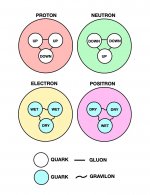
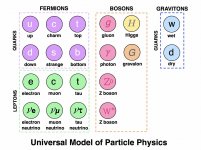
My hypothesis is that gravity is like quarks and gluons, which hide in protons and neutrons; but instead of hiding in protons and neutrons, there are guarks and gravalons that "hide" in electrons, which makes a bit of sense because electrons are everywhere and like photons they can appear and disappear in the Higgs field or the modern analog of the "ether".
Mostly, the hypothesis is based on efficiency in the sense of reusing rather than doing something completely and totally different.
On the music side, there are tiny particles or packets of waves called "phonons", and these have been verified to be able to become entangled with photons.
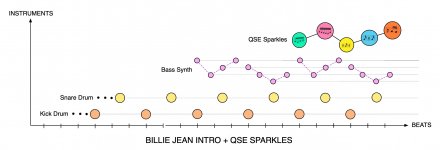
My hypothesis in this regard is that it's possible for phonons to become entangled with the parts of the human mind which are focused on auditory perception, which then leads to my hypothesis of Quantum Sonic Entanglement (QSE) and the idea that tiny snippets of audio, which I call "QSE Sparkles" are key components of hit songs, which I think is verified in the classic Michael Jackson song "Billie Jean", where there are over 150 tiny snippets of vocal and instrumental sounds, including the classic Elvis Presley "hiccups", was started as a nervous tic but then Elvis observed the teenage girls went berserk when he hiccuped and then decade later Michael Jackson connected the dots.
Lots of FUN




 JB
JB