You're really underestimating Pete Brown, the stated Microsoft manager for this project. With him on the case, a daunting project like this won't necessarily be built in a day, but he won't rest until it's right—kinda like how after some growing pains the new Windows MIDI 2 provisions aren't hanging anyone up anymore and just work. He's also tight with Steinberg. Sadly, neither Presonus nor Fender has shown the least inclination to work tightly with Microsoft or the MIDI Association. That's what I personally wouldn't hold my breath over.It's a waiting game for windows, there is a promised Windoze Asio driver... I wouldn't hold your breath on it tho'

GitHub - microsoft/low-latency-audio: ASIO driver development for Windows
ASIO driver development for Windows. Contribute to microsoft/low-latency-audio development by creating an account on GitHub.github.com
Regards to all.

-
Hi and welcome to the Studio One & Studio Pro User Forum!
Please note that this is an independent, user-driven forum and is not endorsed by, affiliated with, or maintained by Fender. Learn more in the Welcome thread!
You are using an out of date browser. It may not display this or other websites correctly.
You should upgrade or use an alternative browser.
You should upgrade or use an alternative browser.
I am going for it!
- Thread starter k2347
- Start date

lokeyfly
Well-known member
I'm possibly missing something here, but the Harrison Flex-10 is ASIO compliant. What is this in relation to?It's a waiting game for windows, there is a promised Windoze Asio driver... I wouldn't hold your breath on it tho'
Skijumptoes
Member
There's an Operating System level ASIO driver being worked on by Microsoft for Windows, so in theory you wouldn't need manufacturer drivers or ASIO4ALL. I think people are hoping it also includes the ability to route audio and offer aggregate devices as you can do on Mac OS.I'm possibly missing something here, but the Harrison Flex-10 is ASIO compliant. What is this in relation to?
Pete from MS is quite active on various forums on the subject, I see him posting a lot on Steinberg board for example.
I never mentioned Pete Brown so that's a bit off. My take, the MS machine is bit of a juggernaut, so he has my blessing and the midi 2 comment is a given.You're really underestimating Pete Brown, the stated Microsoft manager for this project. With him on the case, a daunting project like this won't necessarily be built in a day, but he won't rest until it's right—kinda like how after some growing pains the new Windows MIDI 2 provisions aren't hanging anyone up anymore and just work. He's also tight with Steinberg. Sadly, neither Presonus nor Fender has shown the least inclination to work tightly with Microsoft or the MIDI Association. That's what I personally wouldn't hold my breath over.
Regards
Hiya Lokeyfly,I'm possibly missing something here, but the Harrison Flex-10 is ASIO compliant. What is this in relation to?
It's a windows Asio sound driver and or the chance to have what Apple call an aggregated device, which would allow the OP to have his channels work as he wants at the system (Windows) level, least I assume that's what he wants from reading the thread.
Kindest regards
Didn't say you did, but his name is right at the top of the image you posted. So it's not just some vague faceless team at an international conglomerate in charge of working on the Windows Asio driver, it's a gifted, dedicated human who's great at interfacing with other industry players and a musician himself driving the bus. And he's been exponentially more forthcoming (at Gearspace, to name one place to easily research him) about what Microsoft is up to to improve life for electronic musicians than anyone at Fender or Presonus.I never mentioned Pete Brown so that's a bit off. My take, the MS machine is bit of a juggernaut, so he has my blessing and the midi 2 comment is a given.
Regards
Last edited:
Hey MisterE,Didn't say you did, but his name is right at the top of the image you posted. So it's not just some vague faceless team at an international conglomerate in charge of working on the Windows Asio driver, it's a gifted, dedicated human who's great at interfacing with other industry players and a musician himself driving the bus. And he's been exponentially more forthcoming (at Gearspace, to name one place to easily research him) about what Microsoft is up to to improve life for electronic musicians than anyone at Fender or Presonus.
That article also had a greyed out statement noting no release date was set, it has been updated since I posted and now reads...
"There is no public release of the driver, yet. This section will be updated with the Windows Insider Build information once the driver preview ships in Windows.
Which was what I was referring to by "don't hold your breath".
You describe my opinion of Pete Brown as lacking and underestimated his tenacity, rather than asking why I might think it will not happen soon?
Please do not make assumptions about my comments, it is misleading and making the discussion about individual people, something I try to avoid!
I will cut a path out of here and you can carry on regardless.
Kindest regards.
Perhaps there's more than one possible interpretation of "don't hold your breath?" That phrase often suggests "it's never going to happen." Perhaps you'd allow for that? Regardless, this is hardly something I'm personally invested in, I'm not here to argue against the fact that big changes take time. Peace out.Hey MisterE,
That article also had a greyed out statement noting no release date was set, it has been updated since I posted and now reads...
"There is no public release of the driver, yet. This section will be updated with the Windows Insider Build information once the driver preview ships in Windows.
Which was what I was referring to by "don't hold your breath".
You describe my opinion of Pete Brown as lacking and underestimated his tenacity, rather than asking why I might think it will not happen soon?
Please do not make assumptions about my comments, it is misleading and making the discussion about individual people, something I try to avoid!
I will cut a path out of here and you can carry on regardless.
Kindest regards.
lokeyfly
Well-known member
I see, as an additional audio interface I/O source, already ASIO compliant. Yes, likely a near distant workaround.Hiya Lokeyfly,
It's a windows Asio sound driver and or the chance to have what Apple call an aggregated device, which would allow the OP to have his channels work as he wants at the system (Windows) level, least I assume that's what he wants from reading the thread.
Kindest regards
The flex 10 manual describes: (among its other features)
● Dual Switchable Line Outputs
● Dual Headphone Outs
Unfortunately, "switchable" not being a part of the dual headphone outs. This would require four out, or two discreet stereo outs.
Given that, I'd suggest k2347 either look for a four out/dual "switchable" stereo out unit, or evaluate where loopback or what they're specifically trying to achieve can happen with this unit. The four out architecture, is not a part of this Flex 10 device, so it seems.
Waiting for some Windows ASIO compliant MIDI2 fix for such a protocol (while coming down the pike at SOME point), doesn't sound like the best answer. Then again, just like beauty, that decision is in the eyes of the beholder.
Nuff time spent on this for me.
TY for clarifying. ; )There's an Operating System level ASIO driver being worked on by Microsoft for Windows, so in theory you wouldn't need manufacturer drivers or ASIO4ALL. I think people are hoping it also includes the ability to route audio and offer aggregate devices as you can do on Mac OS.
Got my hands on one this weekend and was thoroughly disappointed. For your sake I hope it was our user error. We had several occurrances where Pipeline would throw multiple different offset values on the same instance of the plugin. You'd tap auto and it would correctly set the latency. Step away from the computer and upon playback, values would have changed. Threw up my hands after a few hours and doubt I'll mess with it again. Good luck.

wst3
New member
It turns out that designing a really good headphone amplifier is not trivial (kinda seems like it ought to be eh?)FWIW headphone amps in most interfaces are more of a problem than I thought. I only realized that after buying a separate, dedicated headphone amp and realizing how much it made the sound of various headphones "open up."
Years ago I worked for a company that was designing an AVB based personal monitoring system. One of my tasks was to design a headphone amplifier that would "make a drummers ears bleed". Now they were just kidding, but the headphones had to be able to cut through noise the drummer was already making.
Fortunately, for me, I had also designed the power supply, which made designing the headphone amplifier a tiny bit easier.
Unfortunately, for me, it had to be able to drive any headphone design. Among other factors, that means handling impedances from around 8 ohms to as high as 600 ohms, maybe higher? And we did not want to hamper low end response, so it had to be direct-coupled. And it could not burn up if you shorted the output by mistake. It was a fun challenge!
I probably spent more time on the headphone amplifier than any other aspect of the design. In the end it turned out well. I wouldn't put it up against a high end, stand-alone device, but it didn't stink.
Disclosure - as much as I am proud of what we built, I still use a (now discontinued sadly) Rane HC-6 headphone amplifier, by far the best sounding, most reliable headphone amplifier for under $1k.
Last edited:
What if anything would you say compares to it in a smaller form factor?It turns out that designing a really good headphone amplifier is not trivial (kinda seems like it ought to be eh?)
Years ago I worked for a company that was designing an AVB based personal monitoring system. One of my tasks was to design a headphone amplifier that would "make a drummers ears bleed". Now they were just kidding, but the headphones had to be able to cut through noise the drummer was already making.
Fortunately, for me, I had also designed the power supply, which made designing the headphone amplifier a tiny bit easier.
Unfortunately, for me, it had to be able to drive any headphone design. Among other factors, that means handling impedances from around 8 ohms to as high as 600 ohms, maybe higher? And we did not want to hamper low end response, so it had to be direct-coupled. And it could not burn up if you shorted the output by mistake. It was a fun challenge!
I probably spent more time on the headphone amplifier than any other aspect of the design. In the end it turned out well. I wouldn't put it up against a high end, stand-alone device, but it didn't stink.
Disclosure - as much as I am proud of what we built, I still use a (now discontinued sadly) Rane HC-6 headphone amplifier, by far the best sounding, most reliable headphone amplifier for under $1k.

SwitchBack
Well-known member
Buy hp amp and earbuds/phones as a compatible set, easy as that.
A personal hp amp for 8-600 Ohms is a crazy requirement. High impedance needs high voltage for power where low impedance needs high current for power, especially when taking into account that there are phones with a pretty low sensitivity out there that need some serious energy to drive them properly. So a jack of all trades amp will have to be half a power plant to fit that bill, and probably will blow up the first couple of phones you try it out on.
So go for a compatible set that delivers exactly what's needed: It's smaller, lighter, and (for battery power packs) runs longer on a load.
A personal hp amp for 8-600 Ohms is a crazy requirement. High impedance needs high voltage for power where low impedance needs high current for power, especially when taking into account that there are phones with a pretty low sensitivity out there that need some serious energy to drive them properly. So a jack of all trades amp will have to be half a power plant to fit that bill, and probably will blow up the first couple of phones you try it out on.
So go for a compatible set that delivers exactly what's needed: It's smaller, lighter, and (for battery power packs) runs longer on a load.
Excellent read. Really puts the work that goes into making something I generally take for granted into perspective.It turns out that designing a really good headphone amplifier is not trivial (kinda seems like it ought to be eh?)
Years ago I worked for a company that was designing an AVB based personal monitoring system. One of my tasks was to design a headphone amplifier that would "make a drummers ears bleed". Now they were just kidding, but the headphones had to be able to cut through noise the drummer was already making.
Fortunately, for me, I had also designed the power supply, which made designing the headphone amplifier a tiny bit easier.
Unfortunately, for me, it had to be able to drive any headphone design. Among other factors, that means handling impedances from around 8 ohms to as high as 600 ohms, maybe higher? And we did not want to hamper low end response, so it had to be direct-coupled. And it could not burn up if you shorted the output by mistake. It was a fun challenge!
I probably spent more time on the headphone amplifier than any other aspect of the design. In the end it turned out well. I wouldn't put it up against a high end, stand-alone device, but it didn't stink.
Disclosure - as much as I am proud of what we built, I still use a (now discontinued sadly) Rane HC-6 headphone amplifier, by far the best sounding, most reliable headphone amplifier for under $1k.
And I'm glad to see someone who knows what they're talking about support my feelings about the HC-6! It's so good! I love that thing.
OP
OP

k2347
Member
Been a few days putting the Flex 10 through the paces and I gotta admit it is the best interface I have ever owned.I have my old as dirt 2 ch ART PRO VLA gen 1 going into the sends/returns......I love that compressor and never understood why people hate it.The inserts,filters and H-Drive on each channel let's me dial in my guitar tone be it electric or acoustic with my fingers and not a mouse and it sounds amazing warm and fat.I bet the farm the Flex 10's price is gonna go up and will sell out fast once people actually try one.I was gonna do a video demo but currently I am just to lazy so maybe over the weekend because nobody is doing any videos on this awesome device except the same 2 or 3 that have been up since the day it was announced.So nice having a hybrid system again.Do yourselves a favor and get one.If you hate it Sweetwater and Amazon have the best return policies.I bet you will not send it back though.
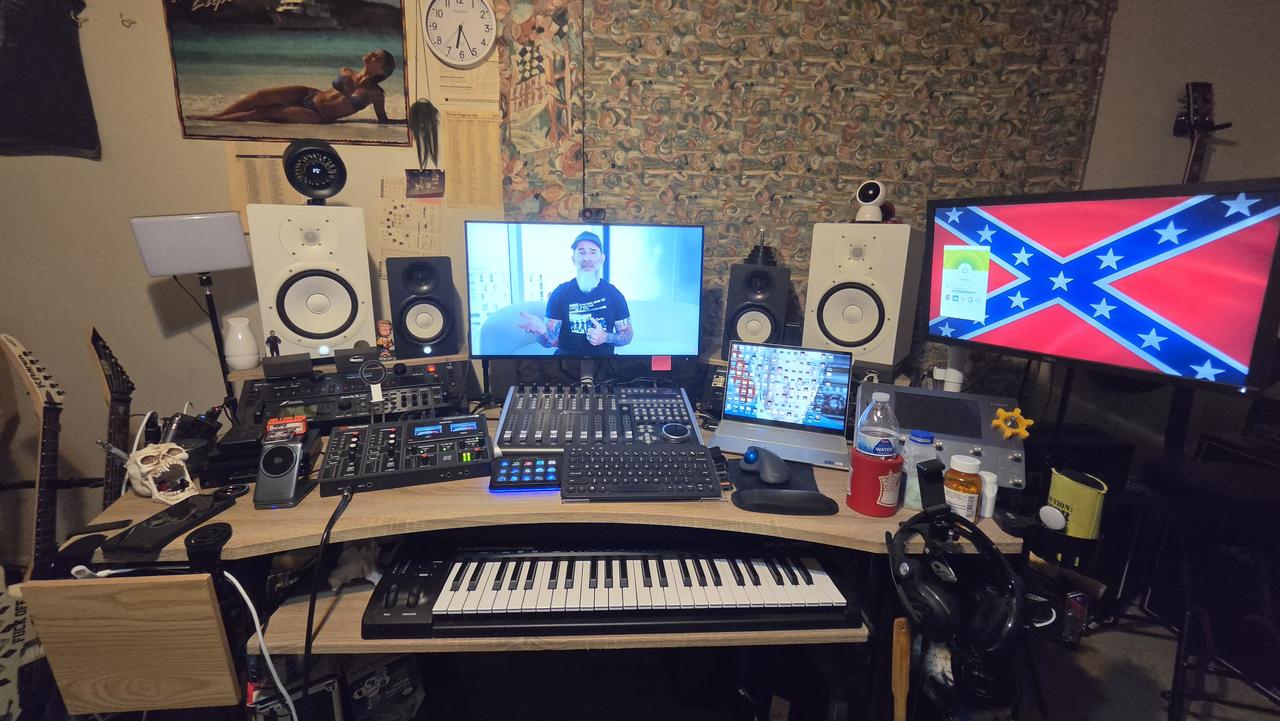
 postimg.cc
Studio — Postimages
lokeyfly
Well-known member
@ k2347, Did you get a definitive answer on separate headphone selections from SSL? This thread is taking turns on how broad the headphone amp impedance might be,to splitting source selection, to MIDI2 to gelp solve your question. We get you're excited about it, and thats great. Only, maybe you could steer some of the questions you've asked here to the good people running through the fence to catch the fly ball. Paraphrasing of course. 
Anyway, glad you approve, but would appreciate the tie-in points.
Anyway, glad you approve, but would appreciate the tie-in points.
lokeyfly
Well-known member
Yes, multiple outputs through your main amd alt 3/4 (switchable, mutable, etc.). But good, you're satisfied with the overall workings of the Flex 10. So theres no real issues as to headphone monitoring levels, etc.
We are quite a receptive bunch here.
Appreciate the first impressions of your purchase. Even the choice of shipoing thoughts. Wooh-hooh, onward and forward.
We are quite a receptive bunch here.
Appreciate the first impressions of your purchase. Even the choice of shipoing thoughts.
Wooh-hooh, onward and forward.
tpittman
Active member
Glad to hear that beautiful Interface is working out as you expected / hoped.Been a few days putting the Flex 10 through the paces and I gotta admit it is the best interface I have ever owned.I have my old as dirt 2 ch ART PRO VLA gen 1 going into the sends/returns......I love that compressor and never understood why people hate it.The inserts,filters and H-Drive on each channel let's me dial in my guitar tone be it electric or acoustic with my fingers and not a mouse and it sounds amazing warm and fat.I bet the farm the Flex 10's price is gonna go up and will sell out fast once people actually try one.I was gonna do a video demo but currently I am just to lazy so maybe over the weekend because nobody is doing any videos on this awesome device except the same 2 or 3 that have been up since the day it was announced.So nice having a hybrid system again.Do yourselves a favor and get one.If you hate it Sweetwater and Amazon have the best return policies.I bet you will not send it back though.
Studio — Postimages
Just as a side note Sweetwater may want to charge you Return Shipping especially
if the product goes over 30 days. Sweetwater is the best to deal with for sure IMO


OP
OP
k2347
Member
I have had the same sales rep at Sweetwater(Ted Hunter)since I think the late 90's????He always does me right but I for the life of me can not remember if I ever even returned anything.20+ years ago Sweetwater dialed me in on my Pro Fools HD2 rig with the 96 and 192 I/O interfaces,Control 24,Argosy desk.......etc,etc,etc.I will never shop anywhere else.Oh and I also own a Sweetwater Creation Station which is still awesome.......it is 10 years old though.