• Hi and welcome to the Studio One & Studio Pro User Forum!

    Please note that this is an independent, user-driven forum and is not endorsed by, affiliated with, or maintained by Fender. Learn more in the Welcome thread!

Any Difference Between Automation and Clip Volume Fades?

Ken Morgan

Member
Simple question (I think). Is there any actual difference between automating a track's volume ups and downs and manipulating passages by separating loud parts using the scissor tool and bringing down (or up) the volume of pieces?

Clip gain vs clip volume, if you will. Old timers (ahem) used to differentiate between gain (electrical) and volume (loudness) - just wondering of StudioPro dropped the distinction much like PT and others.
 
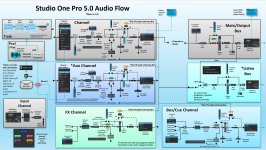
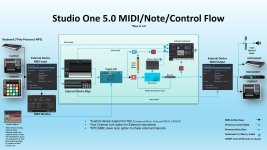
I've wondered about it, too. Found these images somewhere. Maybe they can help.
 

Attachments

  • Studio One 5.0 Audio Flow HD.jpg
    Studio One 5.0 Audio Flow HD.jpg
    331,6 KB · Views: 4
  • Studio One 5.0 MIDI Flow HD.jpg
    Studio One 5.0 MIDI Flow HD.jpg
    224,7 KB · Views: 3
That does right handily, thanks...I noticed that was was for Ver 5 - hoping that architecture still holds for SP8.

I first started using this method in Samplitude 6 with the flagship Sequoia offering 4 point implementation- they called it object oriented mixing, and it was (to me) a very intuitive was to do things. Most others caught up eventually but implementations varied.
 
Mainly, clip volume fades , or "clip gain" impact gain level. The initial level before reaching the channel faders.
Automation, as in volume automation will be the equivalent of moving your faders. Both impact volume, only gain being a little more critical for keeping a desired level passing through your channel.

They both have their uses, so explore what suits your needs. Speed in adjusting volumes, as well as adjusting sensitivity play a roll, so its one of those things best left exploring your own needs which will work best for you.

For example, gain adjustment could greatly impact a guitar level. So if the signal is too hot in one area, like a spike that is too high in level, it would be best served to reduce the clip gain at that spot to reduce that spike. If the signals were fairly consistant with plenty of headroom, and you needed to gain ride by moving a fader, then automation will be preferred. [Note: "gain ride" is often a poorly used term, as it's better suited to be called "level ride".]

There are no hard rules, but there are areas where you have to treat gain with a closer watch for headroom.

Automation will be preferred if you have the need to re adjust levels during a performance. Which can be more often. So its probably worth thinking of clip gain alterations as more surgically focused. And automation as more mix focused.
 
Back
Top