• Hi and welcome to the Studio One User Forum!

    Please note that this is an independent, user-driven forum and is not endorsed by, affiliated with, or maintained by PreSonus. Learn more in the Welcome thread!

Critique Track Button (AI Feature)

lokefly,

I’m not following all you are saying. But I am trying.

Far from it for me to “gunk up the works” in Studio One. I’m not even on the development team.

But since you mention gunk, in your opinion did stem separation gunk up the works?

In the end, aren’t all update decisions made exclusively by the PreSonus team?
I’m a nobody in that regard. In the big scheme of things if my request has no place in the vision of S1, then it has no place and will never be implemented.
Evidently, you're unable to track much of what's going on with tracks as well as dialogue, and that is a pun intended. I earlier wrote "Respectfully, the OP is asking and in his later response mentioned is hoping for that AI "track button" in Studio One. That's fair, I'll guess. I'll leave the subject alone with respect to the forum guidelines and the OP genuinely asking".

I aso put a happy face, along with "(joking)" after stating "gunking up the works". Although, that's on me. I shouldn't have taken your request so lightly, so for that I do apologize. Yes, you obviously aren't part of the development team. Phew.... ducked a bullet, there.
And I’m confused by your huge jump from a request for a “simple” bass tab generator to an AI that can produce “another Beatles”.
You brought forward, so many AI bulleted benefits to a few of us not exactly in lock-step agreement or in awe of your AI Critique button. So let's not cherry pick, shall we. It was you in fact mentioned "There will not be any area of human interest that AI will not significantly contribute to. And in many areas it will surpass human capability". On the contrary. Much the way humans in some fields won't match AI, the same can be said that AI will not match human capability. You volunteered Paul McCartley, I volunteered Beatles. Figure it out. We needn't reach for an AI button for that.
how you are interpreting this thread?
Like many. By hoping for the best outcome with bettering Studio One on a whole for everyone. That includes earning ones creative keep. Also more substance and less feature laiden fluff.
I also suggested that you can use the Made in Studio One forum here for actual human responses now. That in an effort to assist.
There's not anything left that will enrich this subject further, but by all means, press on. It's your position for an AI critique button, with recommendations and a pat on the head.
Go for it. Of course the developers will weigh in on such a thing. Why is that even brought up? This is a forum, and having Studio One work well with many other possibilities, and be functionally Iean is important to all. That was also brought up.

I think the best suggestion was made earlier that there's a site for such critique. Use that! Having a track by track AI Critique button in Studio One, has (and this is respectfully my opinion) the implications of having far too many training wheels on it.
 
Last edited:
Hey man, all is well.

AI happens to be one of my many interests but I'm not a fanatic about it. As a matter of fact, one of my "boundaries" for mankind is to not let this technology become sentient; not even in the lab. If we do, all I see is trouble ahead. But I do see value in an AI-enabled bass tab generator and if PreSonus crosses that finish line first, so much the better.
We are talking about AI here as if it was already AI.
It is not. All AI available today is LLM, diffusion models or other very impressive machine learning - but it’s a pure marketing trick to label that AI and it works, it’s the talk of the town.
However, it’s been around singe the 1950s - though impressive breakthroughs have been made during the last 15 years.

Before we see a Terminator or Matrix scenario there will be a long time. If ever.
 
We are talking about AI here as if it was already AI.
It is not. All AI available today is LLM, diffusion models or other very impressive machine learning - but it’s a pure marketing trick to label that AI and it works, it’s the talk of the town.
Completely agree, and the romance over AI should really be better curtailed. Hey, people will want to have assistance with some lyrics (I wont), or a bass line. Sure, I get it, but what this actually is, is a variety of models that simply randomize on a basis of some set of variables. It's a huge amount of variables at that, and has the vast majority of people thinking gee, that's just amazing! Well, I hope such slight of hand hoodoo stays out of Studio One.

Usage case: I was just working on a song with a world type genre. The bass part has this Tony Levin vibe going on (lovin' it). The last thing I need is to accidently hit a track button that suggests it's nice, but could use a [whomever] bass line, and would I like to try that. Because quite frankly, option available or not, I think I'd have to fix a nearby window after that. If anyone gets my drift.

Thank you, TDF1981.

But hey, others can pick and choose. I just wonder sometimes what the stakes are in offering something that the user hasn't tried (or attempted) alternatives or even actually worked at.

BTW, to the OP [OneBass], I saw an ap called Co Producer that offers sample alternatives. https://output.com/products/co-producer
Maybe, let's avoid the track qritique button part in Studio One for a while. Mmv.

In any case, there's also creating a feature request on the Presonus forum. See how it progresses. But I'd like to know the actual effort background from the OP on this. i.e. past experiences with specifically, Studio One track issues, lack of some bass samples, etc. Not just stuff-in more would-be features that effectively aren't AI in the first place.
 
Last edited:
For me, AI as described here would be cool if implemented in learning tools; playing instrument, song craft, etc. Not so much interest for me in actual production tools. IMO, to the extent AI alters a production, it's like cheating. I say this because music is from the human soul.

Having said that, if one button solutions are implemented I can always ignore them ;)
 
Like many. By hoping for the best outcome with bettering Studio One on a whole for everyone. That includes earning ones creative keep. Also more substance and less feature laiden fluff.
I agree.
I also suggested that you can use the Made in Studio One forum here for actual human responses now.
Yes. And what do you think the liklihood of someone responding with a quality bass tab in the style of Sir Paul is? And in a timely manner?

To better understand where you are coming from I was hoping you would answer the question on whether you think the stem separator "gunked up the works". If you think yes, then I better understand why you would oppose my vision. If no, then I'd be interested in knowing how AI-assisted separation differs in principle from what I'm proposing.

PS> To those that are participating in this intelligent discussion, keep your opinions coming. There is much to explore here.
 
I would never dismiss the usefulness of AI. It's a tool. Like any tool, how it's used and the benefits it delivers depend on the humans using it.

Here's my problem with AI and the arts: It can only work with what has come before. It can create something with the look and feel of originality, but at its core is what has come before. Sure, it could make a suggestion about a bass line. But it probably won't say "consider changing the rhythm guitar part to better match the drum changes you're going to make in about an hour, and then have the bass work better with the guitar. That might solve the issue with the drums."

One could argue that humans stand on the shoulders of giants, and that anything we do is based on what came before as well. But this isn't exactly the same thing, because my personal experiences come into play. For example, AI combined with machine learning could generate a solo in the style of John Coltrane. But if I attempt to play a solo in the style of John Coltrane, it will be influenced by my past experiences and current state of mind. Those are qualities AI algorithms do not yet possess, and I can't imagine writing a prompt so detailed that it includes information on what I felt when hearing John Coltrane for the first time, let alone how my views of his playing evolved as I followed his works over the years, combined with a complete enough description of my state of mind for AI to decide whether the solo should sound more "happy" or "sad" (or something more nuanced, like "bittersweet").

A significant aspect of reggae came about because the Florida radio stations being picked up in Jamaica would fade in and out. Jamaican musicians recognized that as an effect that could be incorporated musically, and furthermore, that perception was also filtered through a haze of pot smoke. Would AI have been able to invent reggae based on listening to Florida radio stations fading in and out while smoking a joint?
 
A significant aspect of reggae came about because the Florida radio stations being picked up in Jamaica would fade in and out. Jamaican musicians recognized that as an effect that could be incorporated musically, and furthermore, that perception was also filtered through a haze of pot smoke. Would AI have been able to invent reggae based on listening to Florida radio stations fading in and out while smoking a joint?
Craig, a superb articulation of my thoughts . . . very well spoken indeed!
To answer your question, my answer is no. I doubt very much that an AI would have been able to invent reggae. But (at least for my purpopses) it doesn't have to invent anything musically at all.

I think George Box said "All models are wrong, but some are useful."
All I'm seeking is more usefulness as described by my original post; ideally from within S1 :)
 
All I'm seeking is more usefulness as described by my original post; ideally from within S1

Understood, but be careful what you wish for! AI making judgement calls about pitch (or about anything, for that matter) is a slippery slope. For example, AI can easily make a value judgement about whether a note is tuned to a fixed scale. But it can't make a value judgement about whether a vocalist's pitch is incorrect, or instead, is a deliberate contributor to tension and release. I also don't want it making a judgement call that my chorus isn't good because it doesn't use the same 4-chord progression that's the basis of soooooo many hits. (FYI - the link is to a YouTube video that's well worth watching 😂)

I see AI and machine learning as best suited to taking care of drudge work, like constantly monitoring the input audio and advising you about levels and if desired, tuning. An example I give frequently is assisted comping. Machine learning could learn over time when you consider a particular comp as acceptable or not. In the process, it would build a database of what characteristics you consider desirable, and weight them accordingly. For example, it might notice that you prefer vocal comps where phrases end in vibrato, and pitch variations are within 25 cents. So if you do 10 comps, and three of them have phrases that end with vibrato and pitch variations within 25 cents, it would suggest you use one of those instead of wasting time auditioning comps that don't have characteristics you want.

But, it couldn't decide which of those comps has more emotional impact.

In general, I'm not particularly interested in AI-driven instant solutions. I'd prefer to have machine learning coupled with AI to understand the mechanics of how I work, and over time, learn how to work with me instead of working for me. It would keep learning over months and years, and gradually refine its ability to make choices that are choices I would make - because its database would consist of choices I made.
 
Last edited:
An example I give frequently is assisted comping.
This is a perfect example of what I meant by “There is much to explore here.” Engaging in meaningful discussion is far more rewarding than simply typing “Dreadful” and hitting submit.

When I first considered this post, AI-assisted comping wasn’t even on my radar in the least. Yet, it might make more sense for PreSonus (or another company) to prioritize comping over a tab generator—or perhaps an entirely different AI-powered tool that would make a stronger business case . . . I don't know. I'm sure there was logic behind sequencing the stem separator when they did.

Many bass players, whether continuing with their learning or not, often fall into what I call a “style trap.” Like many other musicians, we develop habits and certain personal playing styles that might be described as calcified. When I write and/or collab on original songs, I naturally craft bass lines that follow the chord progression. Other times, I separate the bass from an existing song and create a new bass line to replace it. I do this purely for fun, the “thrill of the hunt”, and research, but inevitably, my style trap emerges—I want to play differently, yet my skill level limits me to what I already know.

This is where an AI-powered bass tab generator could be valuable. It could generate tabs in different styles for us to use as-is or modify as needed. A tool like this could even offer “Make Busier” or “Make Simpler” options, providing fresh perspectives and styles that are beyond the bass players comfort zone.

I imagine this struggle applies to many other non-professional musicians, including guitarists, vocalists, pianists—even the guy in the corner with his harmonica. But I'll let these cats plead their own case :D

PS> Funny YouTube, thanks for sharing.
 
Engaging in meaningful discussion is far more rewarding than simply typing “Dreadful” and hitting submit.
It's not their fault. The tone of "AI in music" conversation hasn't been set by musicians, but by people like Mikey Shulman (Suno's CEO). On a podcast, he said “It’s not really enjoyable to make music now. It takes a lot of time, it takes a lot of practice, you need to get really good at an instrument or really good at a piece of production software. I think the majority of people don’t enjoy the majority of time they spend making music.”

Boo hoo, music is hard. Oh Suno, sell me the dream of "from idea to hit" (their home page says this). No wonder when someone says AI, this is the mentaity that comes to mind. Or the hip people in YouTube commercials nodding their heads with orgasmic pleasure as they push a button to have some "AI" genie vomit out a dope pro chord progression.

Hey, that's cool, people getting involved with music on any level is great. But selling them on the idea that they're making hits, and having 18% of Deezer's uploads being AI-generated swill, is a bridge too far. I listened to all the song's on Suno's home page so you don't have to. I wouldn't listen to any of them a second time. Any random song from "Made in Studio One" is way, way better.

So I'm happy to rail against AI, too - just wait until you see my June "Open Channel" column in Mixonline. And I don't want a bass part like Paul McCartney. I'm a better bass player than him - for my music. My joy is in learning, growing, trying, failing, creating, discovering, reaching, falling, practicing...all that messy stuff. That's what music is about, not having a machine create something with the "look and feel" of music. Which is very easy to do these days.

Push yourself to make better music. Be your toughest critic. Always reach for more. Technology can't make value judgements and has no taste. But it sure can be helpful...just ask Studio One :)

/Rant
 
This is where an AI-powered bass tab generator could be valuable. It could generate tabs in different styles for us to use as-is or modify as needed. A tool like this could even offer “Make Busier” or “Make Simpler” options, providing fresh perspectives and styles that are beyond the bass players comfort zone.

You need to read my blog posts about Studio One's collaborative robot bass player. But that's another story, for another thread.
 
AI of course is not an all or nothing thing. A lot of writing and producing a song is guided by (e.g. music theory) rules and routines. AI should be able to do the heavy lifting there. Stuff like writing out the scores for the studio musicians, setting up a mix as per your previous preferences, or checking for (unintended of course) plagiarism. Nothing inspired or creating something completely new here, but taking your doodles, riffs, lines and whatnot through the tedious steps that always follow. And you'll always have the final say. Think moulding clay rather than painting an aquarel. You do the "I wrote that song in 5 minutes in the back of the bus" thing, have AI bring that 90% of the way to where others can work with it too, you do the crossroad decisions and the final touches, being in charge of the whole process all the time. Right?
 
I would never dismiss the usefulness of AI. It's a tool. Like any tool, how it's used and the benefits it delivers depend on the humans using it.

Here's my problem with AI and the arts: It can only work with what has come before.

To view this content we will need your consent to set third party cookies.
For more detailed information, see our cookies page.
 
As a matter of fact, one of my "boundaries" for mankind is to not let this technology become sentient; not even in the lab. If we do, all I see is trouble ahead.

Then why are you posting about it? Asking about it? Or dare I say - promoting it?

Ironically - the more you mention it - in any way - the more sentient it becomes.

For me - if the slightest nod to Ai finds it's way into Studio One - the user base will be -1.

I will do my own basslines, critiques and so on - and then have my real live human colleagues pass along the tips and tricks.

"Technology can't make value judgements and has no taste"

Right on.

VP
 
If AI is generating music inside the DAW, what effect does that have on copyrighting your work?

Due to the inability of AI to create, and only imitate already created works, the US courts have ruled that AI music can't be copyrighted.
 
If AI is generating music inside the DAW, what effect does that have on copyrighting your work?

Due to the inability of AI to create, and only imitate already created works, the US courts have ruled that AI music can't be copyrighted.
I've been wondering how AI will impact the IP lawsuit business model. Music, code, machine designs, etc.
 
Maybe an AI limiter would be a good application. You'd specify a level you didn't want a signal to exceed, AI would analyze the waveform, and destructively attenuate individual cycles to keep them under the specified ceiling. No artifacts, no attack time, no lookahead.
 
It's not their fault. The tone of "AI in music" conversation hasn't been set by musicians, but by people like Mikey Shulman (Suno's CEO). On a podcast, he said “It’s not really enjoyable to make music now. It takes a lot of time, it takes a lot of practice, you need to get really good at an instrument or really good at a piece of production software. I think the majority of people don’t enjoy the majority of time they spend making music.”
I listened to that podcast. A few take-aways. I find him quite articulate in what he is promoting (not to be confused with agreeing with every thing he says). He says there's the old industry and then there's the disrupters. If in fact Mr. Shulman is setting the tone of AI in music and if many disagree with him, then where/who is the counter-balance voice? Is there such a thing as the International Society of DAW Manufactures or other relevant trade group or society? If so, what do they say on the matter? If no such group exists, why?
And I don't want a bass part like Paul McCartney. I'm a better bass player than him - for my music.
I wish I could say the same.

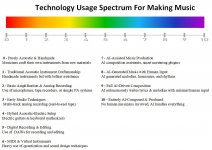
In many a varied context I like to say "We are all on the spectrum." In this context I generally swim somewhere between 6 and 7.
I'd be interested where others swim.
 

Attachments

  • Technology Usage Spectrum.jpg
    Technology Usage Spectrum.jpg
    99,6 KB · Views: 8
if many disagree with him, then where/who is the counter-balance voice?

Well there's me, an outspoken advocate of Artificial Stupidity. But on a far grander scale, there's this initiative. And if you read the article I linked to above, lawsuits are being instituted to rein in AI.

He says there's the old industry and then there's the disrupters.

The problem with disrupters is when the goal is disruption. Ideally, assessing consequences needs to be part of the disruptive process. People in this forum are assessing the consequences of adding "AI" functions to Studio One. I believe they're correct that the consequences of adding these functions would likely detract from Studio One's ability to introduce more universally-needed functions.

Reality check: Studio One's development team needs to work within the confines of finite resources. So far, even Apple - with its massive resources - hasn't been able to implement the AI it promised for its iPhones.

I'll shut up for now...
 
Back
Top